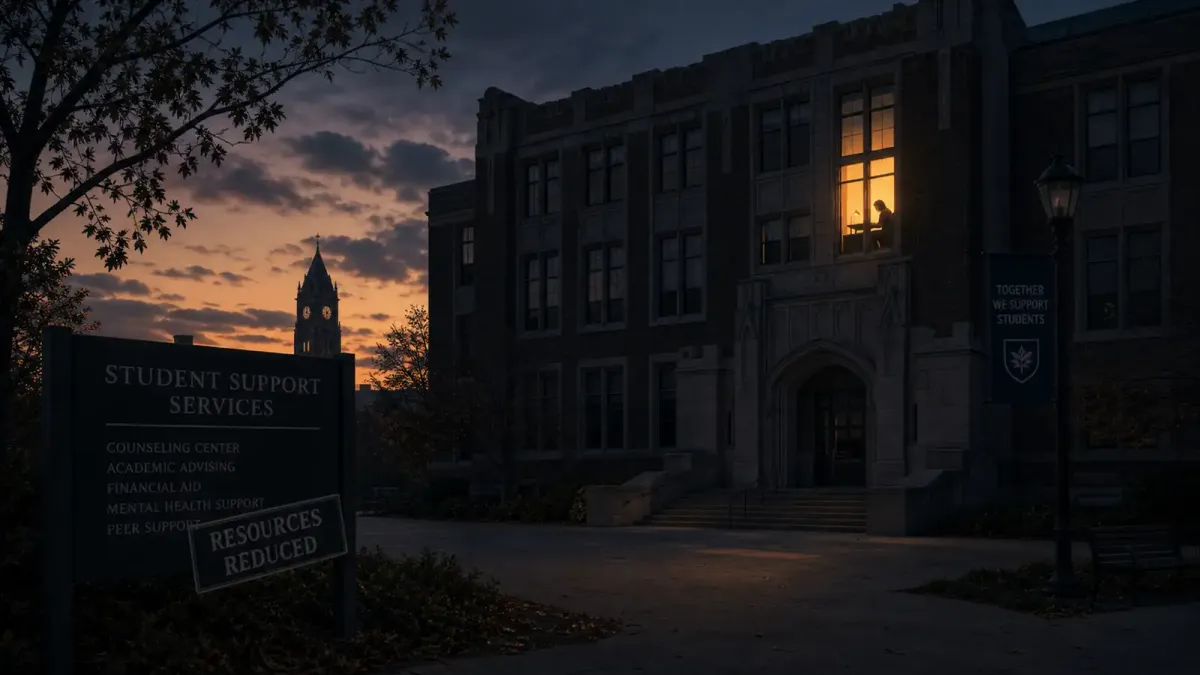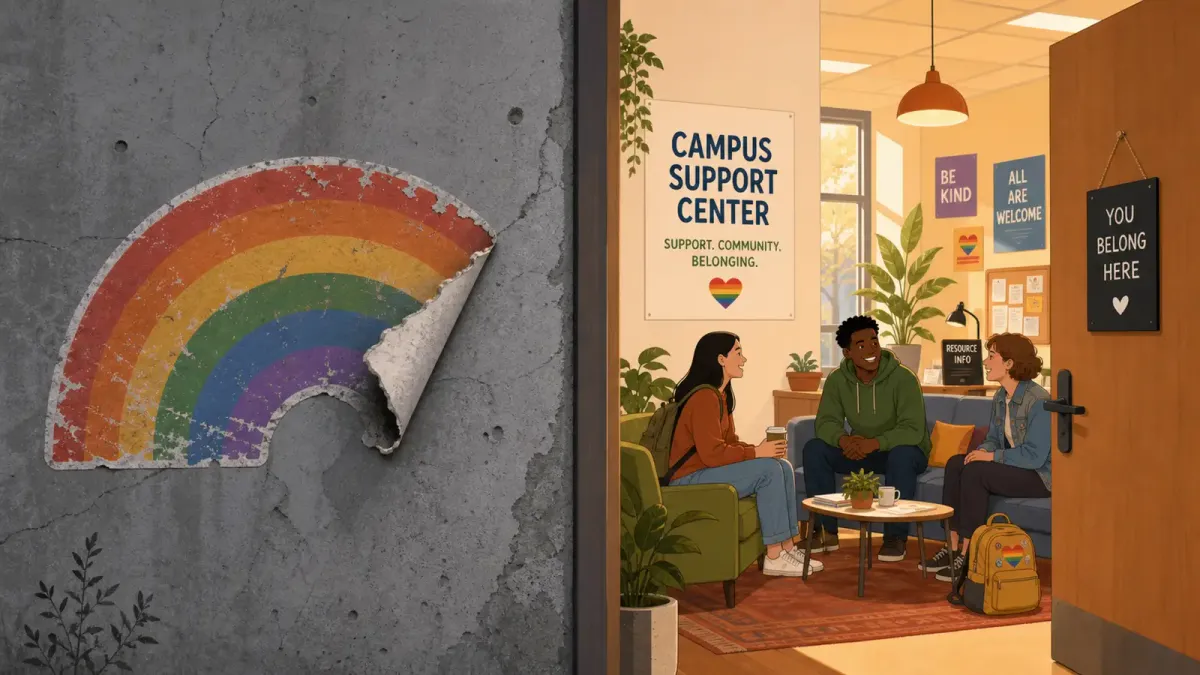
A rainbow flag in the campus center lobby. A Pride Month post on the university Instagram. A “You Are Welcome Here” sticker on a professor’s office door. These gestures take work to coordinate and someone somewhere probably means them. But for an LGBTQ+ student trying to figure out whether a campus will actually have their back, those signals are not the same thing as support. Maybe the housing assignment goes wrong and nobody knows how to fix it. Maybe the counselor doesn’t get it. Maybe you’re not sure where your next meal is coming from and the campus food pantry closes at 4 p.m.
The gap between what a campus says about LGBTQ+ inclusion and what it actually delivers is real, and it is wider at some schools than others. Knowing how to evaluate the difference helps. So does knowing what to do when the institutional safety net has holes in it.
How to Tell If Your Campus Means It
There is a useful starting question: if you stripped away every rainbow flag, every social media post, every performative gesture — what would be left?
At CSU Northridge, researchers asked students a more direct version of that question in 2019. A campus food security survey found that 48% of students had low or very low food security. But almost none of them were using the campus food pantry. The barriers were specific and familiar: stigma around needing help, not knowing where to go, and a system where resources were scattered across different buildings, different websites, different phone numbers.
That data led to the Valera NEST, the first centralized basic needs hub in the California State University system. It opened as a one-stop space for food assistance, housing support, financial guidance, and wellness services. The name stands for Nurturing Environment for Students to Thrive. The design, by CannonDesign, deliberately avoided the institutional, fluorescent-lit feel of a government services office. It was built to look like a place you would actually want to walk into.
That’s a useful benchmark. A campus that means it does not just fund services. It removes the friction between students and those services. It addresses the stigma. It makes the path from “I need help” to “I got help” as short and as dignified as possible.
The Campus Pride Index, which rates schools across eight categories including housing, counseling, policy inclusion, and campus safety, offers another way to benchmark. Schools that make the “Best of the Best” list are not just checking boxes. They are the ones where LGBTQ+ support is woven into how the institution operates, not bolted on for June.
Start With Basic Needs. Everything Else Builds From There.
It’s hard to focus on finding community or succeeding in class when you’re not sure where your next meal is coming from or whether you’ll have a place to sleep next semester. Basic needs insecurity hits LGBTQ+ college students harder than the general student population, though precise national data is frustratingly thin — most campus surveys don’t cross-tabulate by sexual orientation or gender identity.
What we do know: students who’ve experienced family rejection, who’ve been cut off financially after coming out, or who can’t rely on going home for breaks are disproportionately navigating food and housing precarity alone. A 2020 study from the Hope Center for College, Community, and Justice found that LGBTQ+ students were more likely to experience basic needs insecurity than their non-LGBTQ+ peers, a pattern that campus administrators are slowly beginning to acknowledge.
The CSUN NEST model is worth knowing about because it’s replicable. The funding came from a mix of sources: student union fees, private donations, and $6 million in state money. That means the model doesn’t depend on a single wealthy donor or a one-time grant. Other CSU campuses are watching closely, and similar hubs have started appearing at schools around the country. If your campus doesn’t have something like this yet, the existence of the NEST gives you a concrete example to point to when you ask administrators: Why not here?
Beyond centralized hubs, here are specific questions worth asking about any campus you’re considering or already attending:
- Is there an emergency fund specifically accessible to LGBTQ+ students, or at least one that doesn’t require parental income verification?
- Does the food pantry have hours that work for students with jobs or evening classes?
- Are there housing options — gender-inclusive dorms, break housing, emergency short-term housing — that don’t require navigating a hostile roommate matching system?
- Does the campus have a basic needs coordinator, and do they explicitly include LGBTQ+ students in their outreach?
A campus that can’t answer these questions clearly with a “yes” has work to do.
When the Institution Falls Short
Even well-resourced campuses have limits. Counseling centers have waitlists. Health centers may not have providers trained in gender-affirming care. Housing offices may have inclusive policies on paper but staff who haven’t been trained to implement them. These gaps are where community-led support becomes essential.
The San Francisco Transgender District — the first legally recognized trans district in the world — offers a model that scales beyond geography. This summer, 11 LGBTQ+ service providers in San Francisco came together to oppose the mayor’s proposed budget cuts, which would have eliminated nearly a quarter of all trans-specific programs in a city widely considered one of the country’s most LGBTQ-friendly. The proposed cuts amounted to less than 0.02 percent of the city’s total budget. It is a brutal illustration of how easily even progressive institutions can treat marginalized communities as expendable.
The coalition’s approach is instructive: they didn’t compete against each other for scraps. They organized together, made the math public, and forced a conversation about priorities. The cuts were partially reversed. That is not a happy ending. Partial victories in a city that should not be cutting at all are not the same as safety. But the episode does demonstrate how support gets built and defended: through coordination, not competition.
On your campus, this translates to knowing which organizations exist, building relationships between them, and recognizing that the strongest safety nets are the ones woven by the people who actually use them. Student-led mutual aid funds, peer support networks, queer student unions that coordinate across identity groups rather than siloing: these are not stopgap measures. They are infrastructure.
A 2026 study from the University of Haifa, published in July, found that Israeli LGBTQ+ teens often avoid seeking mental and medical healthcare because they expect to be misunderstood or inadequately treated by providers. While the study is specific to Israel, the pattern it describes — avoidance born of anticipated dismissal — is one that LGBTQ+ students on U.S. campuses will recognize immediately. When the official channels feel unsafe or insufficient, informal networks fill the void. The work is to make those networks visible, connected, and sustainable.
Navigating Healthcare and Mental Health Support
The Haifa study’s findings mirror what many U.S. campus health centers quietly struggle with: providers who want to help but lack specific training, intake forms that don’t accommodate diverse identities, a general sense among queer students that they’ll have to educate their doctor before they can get treated.
Some practical steps that can make a difference:
- Ask the health center directly whether any providers have completed LGBTQ+ cultural competency training. If the answer is no, ask whether they have a plan to change that.
- Look into telehealth options. Platforms like Folx Health and Plume specialize in LGBTQ+ care and may be covered by student insurance or available on a sliding scale.
- If you’re searching for a therapist, the question “Do you have experience working with LGBTQ+ clients?” is fair and necessary. A therapist who hesitates or gives a vague answer is giving you useful information.
- Know that you don’t have to disclose everything at once. A first appointment can be about assessing fit. You are interviewing them as much as they are assessing you.
We have written before about how peer support programs help LGBTQ+ students thrive and about finding mental health support on campus. Both are worth reading alongside this piece. The peer support model, in particular, bridges the gap between institutional resources and the informal care networks that so many queer students rely on.
A Practical Checklist
If you’re evaluating a campus, preparing for a new semester, or trying to figure out what support exists at the school you’re already attending, here are the questions that cut through the noise:
- Does the campus have a dedicated LGBTQ+ resource center? If yes, what are its hours, where is it located, and is it staffed by full-time professionals or primarily by student volunteers?
- Is basic needs support centralized and accessible? Look for a hub like CSUN’s NEST. If there isn’t one, map out where food, housing, and financial resources live, and whether the people running them have thought about LGBTQ+ students specifically.
- What does the Campus Pride Index say? Check your school’s rating and, more importantly, which categories it scores low in. A school with strong housing policies but weak counseling resources is a different kind of challenge than the reverse.
- Are there mutual aid networks or peer support programs? Student-run efforts may not show up on the university website. Ask around. Check Discord servers, Instagram accounts, and the bulletin board at the resource center.
- What’s the healthcare situation? Know whether affirming providers exist on campus, what telehealth alternatives are available, and what the student insurance plan covers.
- Who are the allies in administration? A supportive dean of students or a basic needs coordinator who actually shows up can change the trajectory of a semester.
The point of this list is not that every campus should score perfectly. Most won’t. The point is to know what you’re working with, because you cannot fill gaps you have not identified.
Real campus support is quiet, durable, and integrated. It’s a food pantry that stays open late enough for students with evening jobs. It’s a health center intake form that doesn’t make you choose between two boxes that don’t fit. It’s a network of organizations that share resources instead of fighting over them. If your campus has some of this, build on it. If it doesn’t, find the people who are trying to create it anyway. They are almost certainly out there.