When your car breaks down and you cannot afford the repair, you miss class. When you run out of meal plan swipes two weeks before the semester ends, you skip meals. When a family argument leaves you without a place to stay over winter break, you couch-surf and hope nobody asks questions.
For years, emergency aid programs on college campuses existed to catch students in exactly these moments. A few hundred dollars for a car repair. A temporary housing voucher. A grocery gift card. Small interventions with outsized returns: students who receive emergency aid are significantly more likely to stay enrolled and complete their degrees, according to research from the Hope Center for Student Basic Needs at Temple University.
But new data suggests that safety net is unraveling — and LGBTQ+ students, who rely on it more than most, stand to lose the most.
The Numbers Are Stark
A new analysis from the Hope Center, based on Trellis Strategies’ Student Financial Wellness Survey of more than 65,000 undergraduate students across 153 institutions nationwide, found that the share of students receiving emergency aid fell from 44 percent in fall 2021 to just 4 percent in fall 2025. That is a decline of roughly 90 percent in four years.
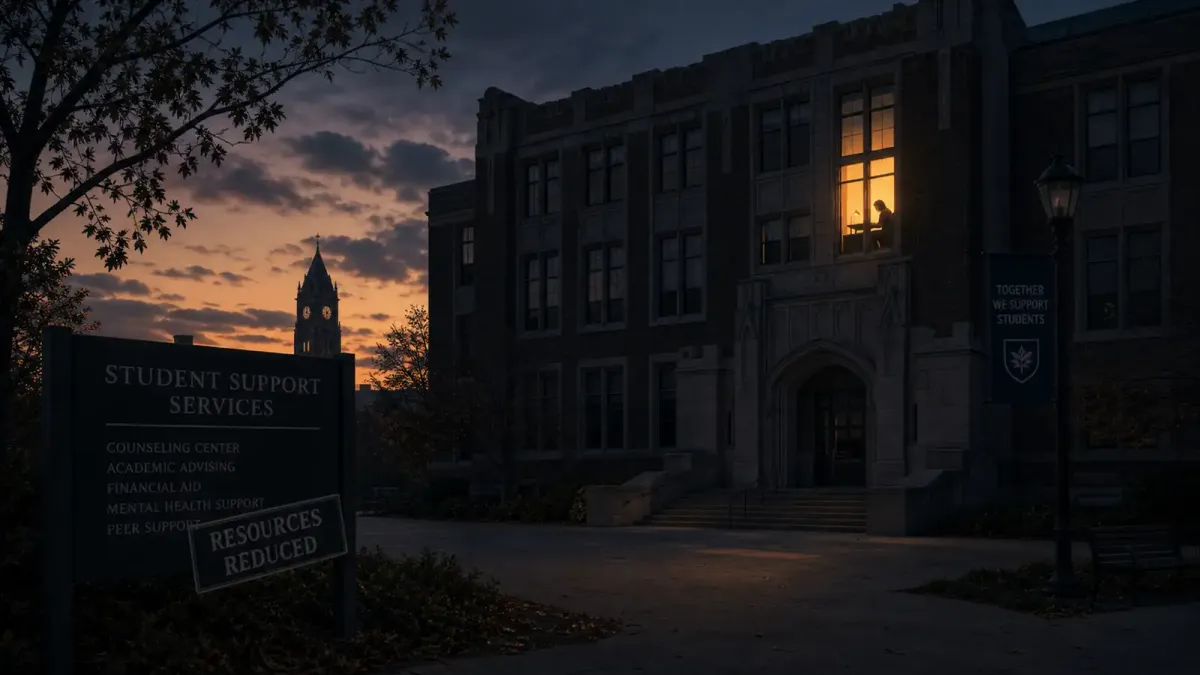
The drop is not because fewer students need help. Food insecurity, housing instability, and unexpected financial shocks have not gone anywhere. What changed is access: more colleges now have emergency aid programs on paper, but far fewer students are actually getting money from them.
Muhammad Kara, a policy and research analyst at the Hope Center, puts it directly: the data suggests schools are either failing to publicize available support or operating programs that are too limited in scope or funding to meet student need. “These have real-world applications,” Kara said. “If a student can’t pay a medical bill or afford food or housing, they are more likely to drop out.”
Why LGBTQ+ Students Are Disproportionately Affected
The decline in emergency aid access hurts all students. It hurts LGBTQ+ students more, for reasons that are structural, not accidental.
LGBTQ+ young adults experience housing instability at roughly twice the rate of their non-LGBTQ+ peers. According to the Trevor Project’s 2024 National Survey on LGBTQ+ Youth Mental Health, 28 percent of LGBTQ+ youth reported experiencing homelessness or housing instability at some point. The Williams Institute at UCLA School of Law has consistently found that LGBTQ+ adults face food insecurity at nearly double the rate of non-LGBTQ+ adults — a disparity that holds even when controlling for income, education, and employment status.
The reasons are not mysterious. Family rejection remains one of the most common pathways to financial precarity for LGBTQ+ college students. A student whose parents cut off financial support after they come out — or who cannot go home over breaks because home is not safe — has no family safety net to fall back on. That is exactly the gap that emergency aid is designed to fill. When the aid disappears, so does the backup plan.
There is also an awareness problem that cuts deeper for LGBTQ+ students. Emergency aid programs are often publicized through channels that assume students are comfortable walking into a financial aid office and explaining their situation. For LGBTQ+ students who have experienced discrimination or dismissal from institutional offices before, that is not a given. The student who has been misgendered at the registrar’s counter is not going to spontaneously trust the emergency fund application process.
What Happened Between 2021 and 2025
Part of the decline has a straightforward explanation: pandemic-era federal relief funding expired. The Higher Education Emergency Relief Fund, or HEERF, pumped billions of dollars into colleges between 2020 and 2023, and a portion of that money went directly to emergency grants for students. When HEERF ended, many colleges did not replace those federal dollars with institutional funds. The programs stayed on the books — it looks good to have an emergency fund — but the money behind them shrank or disappeared.
The expiration of federal relief exposed a structural problem that the pandemic money had temporarily papered over. Emergency aid was never a built-in line item in most college budgets. It was a patch — first funded by one-time federal grants, then sustained by the assumption that something else would come along. Nothing did.
The Hope Center’s analysis suggests something else is happening too: the process of getting aid has become harder to navigate, even at schools that do have funding. Applications that require extensive documentation — pay stubs, eviction notices, medical bills — create a paradox where the students most in crisis are the least able to produce the paperwork required to prove it. Eligibility criteria that exclude students in the gray areas between “crisis” and “inconvenience” — the car that still runs but needs a repair, the rent that is not overdue yet but will be next month. Approval timelines that take weeks when a student needs help in days.
Kara recommends several fixes: automatic qualification based on existing financial aid data, simplified applications that do not require students to retell their trauma in triplicate, proactive outreach instead of waiting for students to find the program on their own, and coordination across departments so a student does not have to tell their story to five different offices.
What LGBTQ+ Students Can Do Right Now
Knowing that the system is failing does not put food on the table. Here are concrete steps LGBTQ+ students can take to find the aid that still exists.
Start with your campus LGBTQ+ center. Even if the center does not administer emergency funds directly, staff there often know which offices on campus actually have money to disburse and which ones are just running websites with no budget behind them. They can also tell you which staff members in financial aid or student affairs are actually supportive — the ones who will process your application without asking invasive questions about why you cannot ask your parents for help.
If your campus does not have an LGBTQ+ center, check with the diversity and inclusion office, the women’s center, or the multicultural student services office. These offices frequently serve as de facto LGBTQ+ resource hubs on campuses without dedicated centers, and their staff may have access to discretionary funds that are not advertised publicly.
Check for LGBTQ+-specific emergency funds. Organizations like the Point Foundation, the Trans Justice Funding Project, and local LGBTQ+ community centers frequently operate small emergency grant programs that do not require the same bureaucratic hoops as institutional aid. These funds are often designed specifically for people who have been turned away by traditional systems. The application might be a Google Form instead of a federal aid verification process. The turnaround might be 48 hours instead of three weeks. Do not overlook these just because the dollar amounts are smaller — a $200 grocery grant solves a real problem.
Use mutual aid networks. On many campuses, informal student-run mutual aid funds — often organized through Venmo, Cash App, or shared spreadsheets — move faster than institutional programs and do not ask for documentation. They are not a long-term solution, but they can bridge a gap while you wait for institutional aid to come through. If your campus does not have one, the campus mutual aid guide has starting points for building one.
Apply before you are in crisis. One of the cruelest features of emergency aid is that it is hardest to access when you need it most — you are stressed, time is short, and the application feels impossible. If you know you are in a precarious situation — your housing is unstable, your food budget is running out, your family support is conditional — apply early. Some programs allow applications for anticipated needs, not just emergencies that have already happened. You do not have to wait until you are sleeping in your car to ask for help with rent.
Document everything. If you apply for aid and get denied, ask why in writing. If the program says it ran out of funding, ask when the next funding cycle begins. Every data point you collect about how the system is failing becomes evidence that student organizers and campus advocates can use to push for change. The 90 percent decline in the Hope Center data started with individual students reporting that programs existed on paper but had no money. Your experience is part of that picture.
What Allies and Faculty Can Do
Faculty and staff who want to help should start by finding out whether their campus emergency aid program actually has money and how long it takes to get it. If the answer is “we have a program but funding is limited” or “applications take three to four weeks,” that is information students need to hear directly — not buried on a webpage they will never visit.
Normalize talking about emergency resources in class and in advising meetings. A simple statement in a syllabus — “If you are experiencing housing or food insecurity, here is who to contact” — signals to LGBTQ+ students that this is a space where their survival is not an afterthought.
Push your institution to adopt the Hope Center’s recommendations: automatic qualification, simplified applications, proactive outreach. These are not radical ideas. They are basic design fixes that determine whether a program actually works or just exists on paper.
The Bottom Line
LGBTQ+ students have always navigated systems that were not built with them in mind. Emergency aid was supposed to be different — a straightforward intervention that catches people before they fall through the cracks. The data says it is failing at that job, and failing hardest for the students who need it most.
The 90 percent decline is not an accident. It is the result of choices: to let federal funding expire without replacing it, to make applications harder instead of easier, to keep programs on the books while starving them of resources. For LGBTQ+ students — who are more likely to need emergency aid and less likely to have family safety nets — those choices compound into crisis. Reversing them will take advocacy, transparency, and a willingness to design systems for the students who actually use them, not the ones administrators wish they had.