Earlier this month, the University of Calgary got an unusual piece of news. The Calgary Pride Board told the university it could not march as an institutional team in the 2026 parade. The official university statement acknowledged the shift with careful language: “The University of Calgary’s participation in the Calgary Pride Parade will look different this year.”
For an institution that has historically sent a contingent to the city’s largest LGBTQ+ event, getting uninvited stings. But how the students and grad student association responded matters more than the university’s statement.
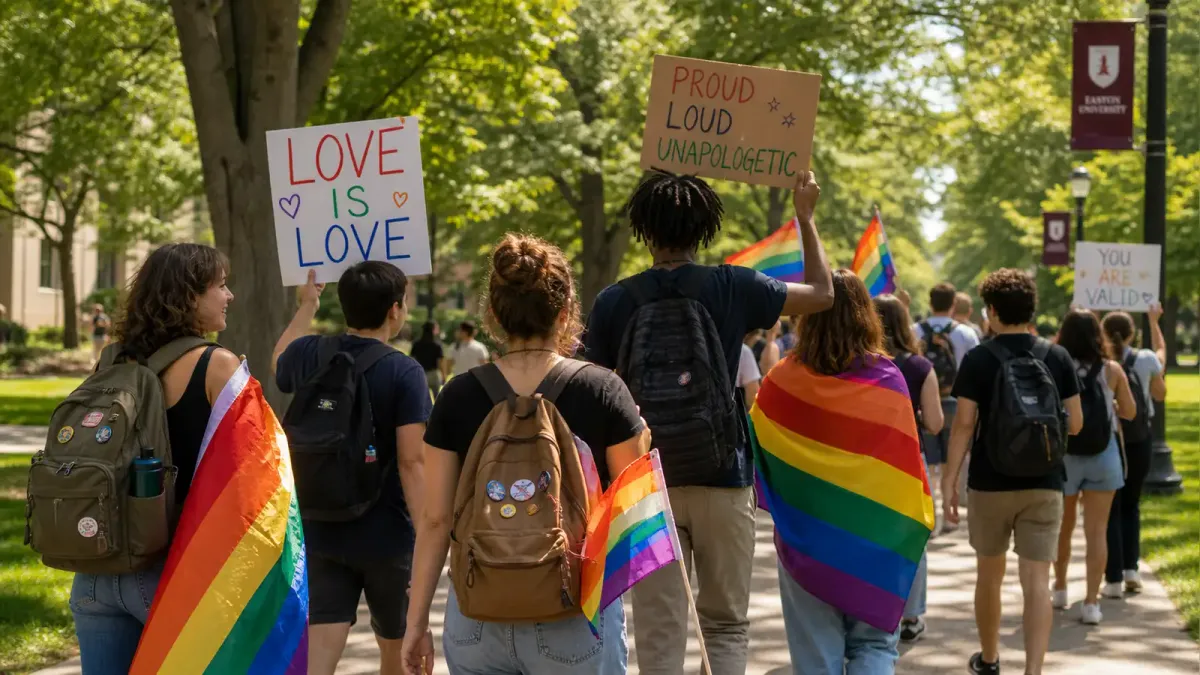
The Graduate Students’ Association (GSA) confirmed it is filing its own application to march independently. Student groups and individual faculties are doing the same. The students’ union, which marched under the Q Centre banner last year, is organizing its own contingent. As the GSA put it: “For many, Calgary Pride offers their first safe opportunity to openly explore and celebrate their identity and connect with the wider 2SLGBTQIA+ community.”
The university lost its spot. The community didn’t lose anything.
A pattern, not an isolated incident
The UCalgary decision didn’t happen in a vacuum. Across North America, the relationship between universities and Pride organizations is shifting. So is the relationship between universities and their own LGBTQ+ students.
At the University of Houston, Senate Bill 17 forced the closure of both the Center for Diversity and Inclusion and the LGBTQ Resource Center, according to reporting by The Cougar student newspaper (The Cougar, June 2026). “The college experience can be overwhelming for all incoming freshmen, but especially for LGBTQ+ students,” the article noted — and with designated safe spaces gone, students had to look elsewhere.
What’s striking is what happened next. GLOBAL, one of the largest LGBTQ+ social organizations on the UH campus, continued operating. It still runs events, still connects students to resources, still builds community. Deeds Not Words, a community-driven social justice organization founded in 2016, kept going. Off-campus organizations like the Montrose Center and LGBT Switchboard Houston stepped in with counseling services.
The infrastructure changed. The community adapted.
That’s the story that gets less attention in headlines about DEI office closures and Pride parade policy changes. The students don’t stop being queer. They don’t stop needing each other. When the official structures shrink or shift, the grassroots structures flex.
What students actually lose when institutional support pulls back
Let’s be clear about what’s at stake. An LGBTQ+ resource center on campus isn’t just a room with a rainbow flag. It’s often the place where a freshman who came from a conservative town first meets people who understand their experience. It’s where students find name-change paperwork help, gender-affirming care referrals, and someone who doesn’t flinch when they talk about their partner.
When that center closes — or when a university’s Pride participation is downgraded from institutional to individual — the symbolic weight lands hardest on students who were already isolated. The student who was about to walk through that door for the first time now has nowhere to walk through.
The GSA at Calgary framed the stakes well: “We are dedicated to ensuring that our campus is a safe and inclusive space for the 2SLGBTQIA+ community. We will continue advocating for the programs, services, and supports our members need.”
That word “continue” is doing a lot of work. It means the work doesn’t stop when the institution steps back. It means the people who were already doing the work — often underpaid staff, often student volunteers — do more of it.
How students are filling the gaps
The pattern across campuses where institutional support has contracted follows a similar shape. Students organize. They find off-campus partners. They show up at Pride anyway.
At UH, GLOBAL’s model is instructive. The organization doesn’t just host social events — it provides “tools and resources needed for success.” That’s language usually reserved for career centers and academic advising. When the official resource center closes, the unofficial one expands its mandate.
At Calgary, the UCalgary Business Pride Club is preparing to host the annual National Pride in Business Conference, an event that brings together LGBTQ+ professionals and students from across the country. The institutional-level Pride ban doesn’t stop student-led initiatives from operating. In some cases, it seems to energize them.
The Gauntlet, the University of Calgary’s student newspaper, reported that the Students’ Union’s participation is proceeding regardless of the university’s institutional status. Last year the SU marched under the Q Centre banner. This year it’s organizing independently. The GSA is filing its own application. Multiple student-led efforts are running in parallel, not waiting for permission from the top.
This matters because it demonstrates something that first-year students often don’t realize: the most durable community infrastructure on a campus is almost never the administrative office. It’s the student organization that has been meeting in the same room on Thursday nights for five years. The faculty advisor who keeps an open-door policy regardless of what the provost’s latest memo says. The group chat that exists independent of any official platform.
The practical lesson for students on other campuses: know what’s actually durable on your campus. An administrative office can be closed by a policy change. A student organization with a committed membership base is harder to erase. If you’re building community, build it with people, not with administrative approvals.
Finding your people when the map changes
If you’re an LGBTQ+ student navigating a campus where institutional support is shrinking or shifting, here’s what the students at Houston and Calgary have figured out:
Map the off-campus ecosystem before you need it. The Montrose Center in Houston was already there when the university’s resource center closed. Every college town or city has community-based LGBTQ+ organizations. The time to find them is before you’re in crisis.
Student organizations are more resilient than administrative offices. GLOBAL and Deeds Not Words at UH predated the SB 17 closures and survived them. The Calgary GSA marched before the university was banned from Pride and is marching after. Student groups that own their own infrastructure — bank accounts, meeting spaces, leadership pipelines — don’t disappear when a university policy changes.
Pride participation doesn’t require an institutional invitation. The Calgary student groups didn’t wait for the university to sort out its standing with the Pride board. They filed their own applications. If your campus won’t send a contingent, your student organization can.
Know who the actual allies are. The UCalgary statement emphasized that “individual faculties, associations, and student groups may submit their own application.” That’s a quietly significant line. The institution as a whole has been asked to step back, but sub-units within it are still welcome. On your campus, that might look like a specific department that keeps its door open, a faculty advisor who advocates behind the scenes, or a group of professors who show up to student events without being asked.
Document the gap. When a resource center closes or a policy shifts, the first thing that gets lost is institutional memory. The Center for Diversity and Inclusion at UH is gone, but The Cougar’s reporting on what existed and what replaced it creates a record that future students can build on. Student journalism, meeting minutes, even a shared Google Doc listing what resources are still available — these are community infrastructure too.
Don’t confuse administrative absence with community absence. The University of Calgary isn’t marching at Pride this year. But queer students, queer faculty, and queer staff at UCalgary will be there. Some will be under the SU banner, some under the GSA banner, some walking with friends. The absence of an institutional logo on a banner doesn’t mean the community disappeared. It means the community stopped waiting for the institution to represent it.
The bigger picture
The Pride parade dispute at Calgary and the resource center closures at Houston are different events with different causes. But they point in the same direction: the institutional relationship between universities and their LGBTQ+ students is being renegotiated one decision at a time.
Some of this is legal. Texas SB 17 didn’t just affect UH — it reshaped the landscape for every public university in the state. Some of it is cultural. Calgary Pride’s decision about the university’s institutional participation reflects a broader conversation about what it means for a large institution to claim allyship at an event that exists because institutions failed the community in the first place.
The students caught in the middle don’t have the luxury of treating this as an abstract debate. They need to know whether there’s a room where they can be themselves, whether there’s a counselor who understands their experience, whether they’ll see people like them when they look around at the next campus event.
What Houston and Calgary show is that the answer to those questions increasingly depends on students themselves — on the leaders of GLOBAL and Deeds Not Words, on the GSA officers filing parade applications, on the editors at The Cougar and The Gauntlet who are documenting what’s happening in real time.
What happens next depends less on university administrations and more on the students and faculty who refuse to let the community infrastructure disappear. The GSA at Calgary is still marching. The students at UH are still meeting. The work continues — not because institutions protect it, but because people insist on it.
If that’s where you find yourself this summer — looking at a campus map that’s changed since you enrolled — the students who’ve been through it have a quiet piece of advice: find the people who were doing the work before the office existed. They’re still there.
And if you can’t find them yet, start showing up. Go to the GLOBAL meeting. Walk with the GSA contingent. Write the article that documents what’s missing. The institutions will keep shifting, one policy at a time. But the community doesn’t need an official office to exist. It just needs people who refuse to let it disappear.
Related reading: Beyond the Rainbow Sticker: How to Evaluate and Access Real LGBTQ+ Support on Campus in 2026, How State Policies Are Reshaping Where LGBTQ Students Choose to Go to College, Summer Break Survival: Maintaining LGBTQ+ Wellness and Belonging When Campus Resources Are Gone