The Supreme Court ruled in June that California can keep its policy allowing transgender students to participate in school sports consistent with their gender identity. The decision was narrow — it let California’s policy stand without establishing a nationwide precedent — but its implications for LGBTQ college students extend far beyond athletics.
Here is what the ruling actually means for the student trying to decide between Cal State Long Beach and a public university in a state that bans trans athletes. It means one campus operates in a legal environment that affirms their identity and the other operates in one that restricts it. Multiply that difference across every dimension of campus life — housing, healthcare, bathrooms, student organizations, faculty training — and you get something that looks less like a choice between two colleges and more like a choice between two versions of what it means to be an LGBTQ person in America.
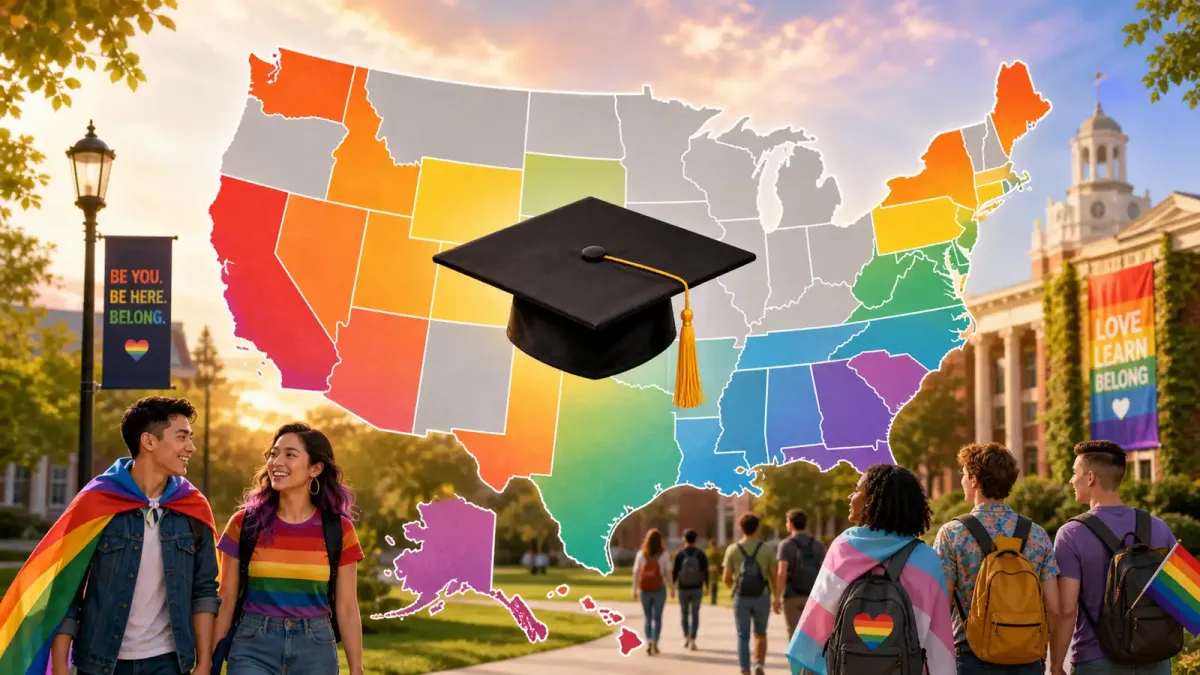
What is happening, quietly and without much national coverage, is that state-level policy divergence is creating two fundamentally different experiences of campus life for LGBTQ students depending on which state their school is in. And students, who are more aware of these differences than any previous generation thanks to social media and peer networks, are factoring them into one of the biggest decisions of their lives: where to go to college.
The patchwork nobody planned
The United States does not have a single policy on LGBTQ students in higher education. What it has is 50 state-level experiments running simultaneously, with results that diverge wildly.
In California, the California Interscholastic Federation allows transgender students to compete on teams that match their gender identity, and the state is actively fighting lawsuits seeking to restrict those rights. Attorney General Rob Bonta reaffirmed the state’s position after the SCOTUS ruling: “We do remain committed to protecting transgender individuals from discrimination, securing safe, inclusive, welcoming school environments for all students.”
In other states, the landscape is the opposite. As of mid-2026, more than 20 states have passed laws restricting transgender students’ participation in sports, access to gender-affirming healthcare, or both. Some states have banned discussion of LGBTQ topics in classrooms. Others have enacted “bathroom bills” that restrict which facilities transgender students can use. The result is not just a legal patchwork but an experiential one: an LGBTQ student’s daily life on campus looks radically different depending on whether they attend school in California or in a state with active restrictions.
This matters for campus life in a way that goes beyond policy debates. Campus life is not an abstraction. It is where you use the bathroom between classes, whether you feel safe introducing your partner at a dorm event, whether the health center will provide the care you need, and whether your identity is treated as a fact of life or a subject of political controversy. When those basics vary by state, they become college choice factors as real as tuition cost or academic reputation.
Students are voting with their applications
The data is still emerging, but the early signals are clear. A 2025 survey by the American College Health Association found that 34% of LGBTQ high school seniors said state laws affecting LGBTQ rights were a “significant factor” in their college decision, up from 14% in 2020. Among transgender and nonbinary students, the number was 52%.
College counselors report the same shift anecdotally. Students who five years ago might have applied to flagship public universities in their home state are now looking at out-of-state options in more protective jurisdictions. The financial math is brutal — out-of-state tuition can be three to four times in-state rates — but for some families, the calculation has shifted from “can we afford to leave” to “can we afford to stay.”
The campuses that benefit from this migration are concentrated in a handful of states: California, New York, Massachusetts, Illinois, Washington, and a few others with comprehensive legal protections. The campuses that lose students are mostly in the South and Midwest. This is creating a sorting effect where LGBTQ students are increasingly concentrated on campuses in states where they have legal protections — which, perversely, may make those campuses feel safer and more vibrant for LGBTQ students while leaving students in restrictive states more isolated than ever.
The students who cannot afford to leave — whose families cannot pay out-of-state tuition, who depend on in-state financial aid, who need to stay close to home for family or work reasons — are the ones most affected by their state’s policies. They are attending college in environments that are legally hostile to their identity not because they chose to but because they had no other option.
What inclusive campus life actually requires
The SCOTUS ruling and the broader policy landscape raise a question that goes beyond legal compliance: what does an actually inclusive campus look like, and how many schools are providing it?
Legal protection is the floor, not the ceiling. A campus in California is legally required to allow transgender students on sports teams. That is a baseline. But a campus that truly supports LGBTQ students does more than comply with the law. It has gender-neutral housing options that do not require students to justify their need. Its health center provides gender-affirming care or has clear referral pathways to providers who do. Its student organizations include active LGBTQ groups that are funded and visible. Its faculty and staff have received training on inclusive practices that goes beyond a one-hour online module. Its campus climate surveys actually measure whether LGBTQ students feel safe and included, and the results are acted on.
A 2026 report from the Trevor Project found that LGBTQ college students at campuses with comprehensive support systems — inclusive housing, accessible healthcare, active student organizations, trained faculty — reported rates of depression and anxiety 40% lower than students at campuses with minimal support. The effect was strongest for transgender and nonbinary students, who reported feeling “a sense of belonging” at rates nearly double those of peers at less supportive institutions.
The gap between legal compliance and genuine inclusion is where most campuses actually operate. They are not actively hostile, but they are not actively supportive either. They have not banned trans students from sports, but they also have not created housing policies that make trans students feel welcome. They have not passed bathroom bills, but they have not added all-gender restrooms to campus maps. They are, in the language of campus climate research, “passively tolerant” rather than “actively inclusive.” And for a generation of students who have grown up with legal rights and expect institutions to affirm their identity, passive tolerance does not feel like enough.
What colleges can do, regardless of state law
The policy landscape is unlikely to become simpler or more unified in the near term. The Trump administration has signaled its opposition to transgender rights protections, and further court battles over Title IX are almost certain. Colleges that want to support their LGBTQ students cannot wait for the legal landscape to settle.
Fortunately, most of what makes a campus inclusive for LGBTQ students is not determined by state law. It is determined by institutional policy, administrative commitment, and campus culture — all of which are within a college’s control regardless of what the state legislature does.
Gender-neutral housing is the single most impactful policy a campus can adopt, and most campuses can implement it without legal obstacles. The same is true for all-gender restrooms, preferred name policies that function across all campus systems, and faculty training programs that actually prepare instructors to handle the situations that arise in LGBTQ students’ academic lives.
Health services are trickier because they intersect with state law, but campuses in restrictive states can still provide referral networks, mental health support, and insurance navigation assistance that makes a meaningful difference even when they cannot provide direct medical care. Student organizations, funded adequately and given real institutional support rather than token recognition, create the peer networks that research consistently shows are the strongest protective factor for LGBTQ students’ mental health and academic success.
The bottom line is that state law sets boundaries, but institutional commitment determines what happens inside those boundaries. A campus in a state with restrictive laws that nevertheless fights to make its LGBTQ students feel safe and supported is doing something different — and measurably more effective — than a campus in a protective state that coasts on legal compliance and calls it inclusion.
The choice ahead
For LGBTQ students and their families, the college search has become more complicated than it was a decade ago. The question is no longer just “where will I get the best education” or “what can I afford.” It is “where will I be safe” and “where will I belong.”
The answers to those questions vary by state, by campus, and by individual circumstance. There is no universal right answer. But the trend is clear: students are asking the question more explicitly than ever before, and they are making decisions based on the answers. The campuses that recognize this shift and respond to it — not with statements of values but with specific, funded, accountable policies — will be the ones that attract and retain the next generation of LGBTQ students. The ones that do not will watch those students go elsewhere, and they will be poorer for it.
Sources: CalMatters (June 2026); Trevor Project (2026 campus climate report); American College Health Association (2025 survey).