On Saturday evening, a vehicle drove into crowds at Berlin’s annual Christopher Street Day Pride parade, killing one person and injuring more than a dozen others. Within 24 hours, the city’s LGBTQ community had organized vigils, defiant performances, and a motorcycle ride through the streets. The message was the same across every gathering: grief, anger, and a refusal to be made invisible.
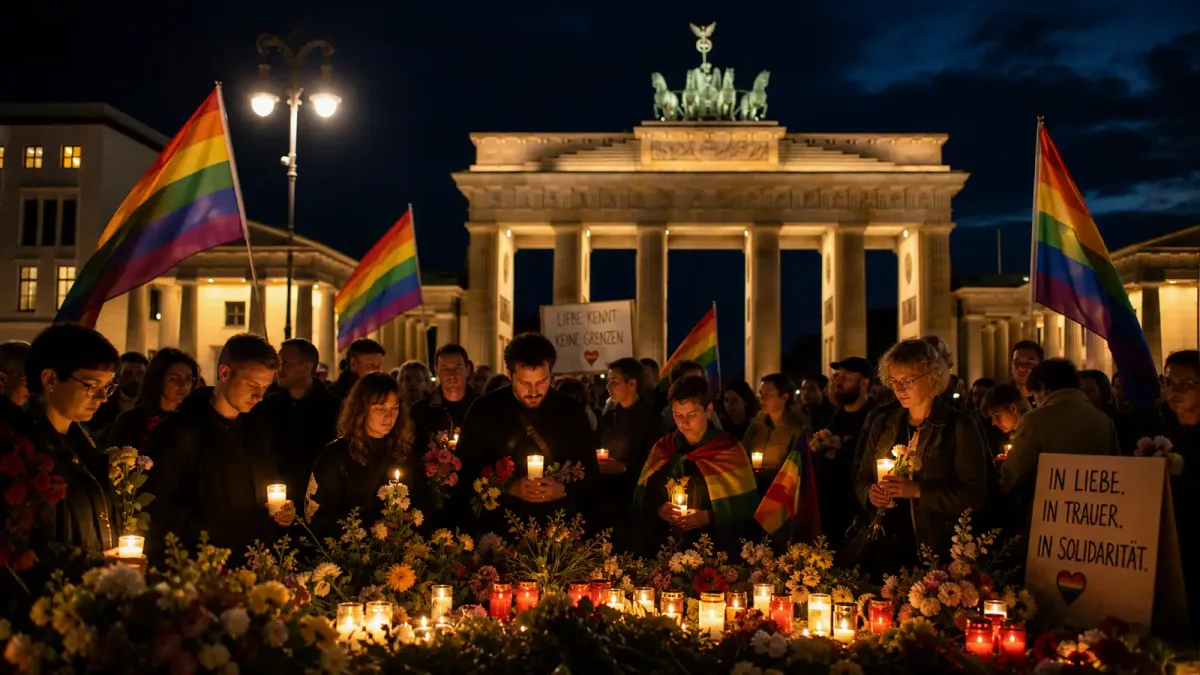
The attack happened near the heart of the celebration route. Police called off the parade hours after it had begun, and organizers cancelled several related events — a breakfast market, a post-parade clean-up — that had been planned for Sunday. The Brandenburg Gate, normally a backdrop for celebration during CSD weekend, became a memorial site instead. Flowers and candles accumulated at the base of the monument through Sunday morning as word spread through the city.
What happened
Details are still emerging from the investigation, but the basic sequence is clear. A vehicle drove into a crowd gathered for Berlin’s Pride celebrations on Saturday, July 25. One person was killed. At least 16 were injured. German authorities treated it as a suspected attack, and news outlets around the world covered it as a deliberate act targeting the LGBTQ community.
Berlin’s Christopher Street Day is one of Europe’s largest Pride events, drawing hundreds of thousands of people each year. The parade runs through the center of the city, past landmarks that carry deep historical weight — including the Memorial to Homosexuals Persecuted Under Nazism in Tiergarten, a short walk from where the attack took place.
How the community responded
The cancellations and police closure of the parade could have been the end of the weekend. Instead, community groups reconfigured the schedule within hours. The D-Dur Dykes, a pop choir, organized a vigil at 2 p.m. Sunday at Pariser Platz, the square surrounding the Brandenburg Gate. The location was deliberate — just a few hundred meters from where the attack happened. Queer Bikes Berlin, a motorcycle group, went ahead with a planned Pride ride on Sunday, turning it into a rolling statement of presence.
Alfonso Pantisano, the Berlin state government’s LGBTQ affairs commissioner, was at Brandenburg Gate when the attack occurred. He posted a message to Instagram that circulated widely through the community in the hours that followed: “To you, my dear community: I know that many of you are afraid right now. I won’t sugarcoat it — I am, too. But you are not alone in this fear, in your grief, and in your anger.”
German rapper Ikkimel, who had performed on stage earlier in the day, wrote: “I hope that many people realise how important it is that we stay strongly together, now more than ever.”
Andre Lehmann, a top official with LSVD+, Germany’s main national LGBTQ+ association, told the Associated Press at an impromptu vigil in Tiergarten that “this suspected attack hits the heart of the queer community.” He described the act as political — “it does not just affect people celebrating” — and said those gathered were expressing anger and shock, but also resilience.
On Sunday night, Haidar Darwish, a Syrian belly dancer and artist, took the stage at Berlin’s Museum Island. Wearing a flamboyant hoop skirt and red fez, he asked the audience for a moment of silence, then told them the show would go on. “Yesterday there was an attack and a hate crime on our community in Berlin during the Pride Parade,” he said, struggling to keep his emotions steady. “It’s heavy on our community but we are pushing through, and we are here specifically today, myself and my artists, to show up and be visible.”
Why Berlin, and why Pride
Berlin occupies a particular place in LGBTQ history. During the liberal Weimar era of the 1920s, the city became an international hub of gay and lesbian life. Bars, clubs, publications, and a visible public culture flourished in a way that was unmatched anywhere in the world. Magnus Hirschfeld’s Institute for Sexual Science, founded in Berlin in 1919, was decades ahead of its time — researching gender identity, offering medical services, and advocating for legal reform. The Nazis destroyed the institute in 1933, burning its library in a public bonfire. The memorial in Tiergarten, dedicated to the gay men and lesbians persecuted and murdered during that period, stands roughly a ten-minute walk from where Saturday’s attack took place.
After World War Two and through Germany’s Cold War division, gay communities gradually re-emerged in Berlin. Bars reopened. Social organizations formed. Political activism rebuilt itself from scratch. Christopher Street Day, named for the 1969 Stonewall uprising on Christopher Street in New York, became an annual fixture in the city’s calendar, growing into one of Europe’s largest Pride events with hundreds of thousands of attendees each year.
The historical weight of the location wasn’t lost on the people who gathered Sunday. Holding a vigil at the Brandenburg Gate, a few hundred meters from both the attack site and the memorial to Nazi persecution, connected the present moment to a longer arc. Andre Lehmann of LSVD+ made this explicit when he told reporters that the attack “hits the heart of the queer community” — a community that has rebuilt itself before, in the same city, under far worse conditions.
The attack also lands at a moment when anti-LGBTQ sentiment is being tracked as a rising trend globally. In the United States, the number of anti-LGBTQ bills introduced in state legislatures has climbed sharply over the past several years. Pride events in multiple countries have faced increased security threats. On campuses, LGBTQ centers have faced funding cuts and political pressure. Online, coordinated harassment of visible LGBTQ people has become a predictable cost of visibility.
In that context, the response in Berlin matters beyond Germany. The pattern that played out — vigils organized in hours, performances turned into declarations, people refusing to let fear decide the next move — is the same one that LGBTQ student groups have used when their own communities have been targeted. It is not a new strategy. It is an old one, refined across generations.
What this means for campus communities
For LGBTQ students watching from campuses around the world, the Berlin attack and its aftermath carry lessons that are uncomfortably practical. The most obvious one: community resilience is built before the crisis, not during it. The D-Dur Dykes could organize a vigil in hours because the choir already existed. The network was already in place. The relationships were already there.
The same principle applies on campus. LGBTQ student organizations, peer support networks, and informal friend groups are not just social infrastructure. They are the mechanism through which a community responds when something goes wrong. Our guide to building peer support networks walks through what that looks like in practice: identifying people who can mobilize quickly, maintaining communication channels that work when official channels fail, and knowing which spaces are safe for gathering.
The second lesson from Berlin is about visibility as a form of refusal. Darwish didn’t issue a statement. He performed. Queer Bikes Berlin didn’t post on social media — they rode. These are not subtle acts, and they are not meant to be. When a community is attacked specifically for being visible — for gathering in public, for celebrating in public — the decision to remain visible is itself a response. It says: you didn’t succeed in making us disappear.
There is a tension here that anyone who has organized on campus will recognize. Visibility carries risk. Not everyone can afford to be visible, and the people who are most visible often bear a disproportionate emotional weight. The Berlin response included both kinds of participation: the people on stage and the people holding candles in the crowd. Both mattered. The choir that organized the vigil mattered as much as the performer who made the declaration.
What the response teaches
There is no formula for responding to violence aimed at your community. But the pattern that played out in Berlin this weekend is one that student organizers will recognize: move fast, gather publicly, refuse to let fear dictate the next move.
The D-Dur Dykes didn’t wait for official permission to hold a vigil. They picked a location, set a time, and spread the word. Darwish didn’t cancel his performance — he turned it into a memorial and a declaration. Queer Bikes Berlin didn’t park their motorcycles. They rode.
None of these actions undo what happened. A person died. More than a dozen were injured. A community that gathered to celebrate was attacked. But the refusal to disappear — the insistence on being visible the very next day, in the same city, a few hundred meters from the site of the attack — is its own kind of answer.
For LGBTQ students, the lesson isn’t abstract. It’s the same one that runs through every community resilience story this site has covered: when institutions fail to protect you, the community you build becomes the safety net. The Berlin vigil wasn’t organized by the city government. It was organized by a choir.
There will be more analysis of what the Berlin attack means for Pride events globally, for security at large public gatherings, and for the political climate that enables violence against LGBTQ people. Those conversations matter. But the story of this weekend is simpler and older than any of that: a community got hit, and it got back up.
The choir sang. The dancer danced. The motorcycles rode. In a city where the Nazis once burned the library of the world’s first institute for sexual science, people gathered the next day with candles and flags and refused to go home. That does not fix anything. It does not bring back the person who was killed or undo the injuries of the people who are still in hospitals. But it makes one thing clear to anyone watching: this community has rebuilt itself before, and it is not stopping now.
Sources:
- Reuters: “Berlin Pride attack prompts grief and solidarity with LGBTQ community” (July 26, 2026)
- AP/Greenwich Time: “A gay belly dancer turns grief into joy after fatal attack on Berlin’s Pride festival” (July 27, 2026)
- AP/Greenwich Time: “A fatal attack on Berlin’s Pride festival leaves locals wondering how their city will recover” (July 26, 2026)