Thirty-nine percent of queer adults have faced rejection from their birth families. Forty percent of homeless youth are LGBTQ. These numbers are not abstract. They describe the reality many students carry when they arrive on campus — the absence of a safety net that most people take for granted.
Chosen family fills that gap. Not as a sentimental idea, but as a functional survival mechanism. When queer and trans students build networks of people who choose to show up for them, the effects ripple outward into academic performance, mental health, and the simple ability to stay enrolled. The research is clear: finding your people is not a nice-to-have. It is a predictor of whether you make it through college at all.
What Chosen Family Actually Means
The term has existed informally in LGBTQ+ communities for decades, but it gained wider visibility during the AIDS crisis of the 1980s and 1990s. When queer and trans people were rejected by their relatives or denied healthcare by their providers, friends and community members stepped in. They became the ones who drove you to appointments, brought you food when you could not get out of bed, and sat with you when no one else would. That is chosen family — not a replacement for biological family, but a parallel structure that provides what biology failed to deliver.
Point of Pride describes it as “love by choice.” The simplicity of that phrase hides the complexity of what it actually requires. Building a chosen family means finding people who will show up consistently, not just when it is convenient. It means trusting people with parts of yourself that your birth family could not hold. For many LGBTQ+ students, it means learning an entirely new skill: letting people in.
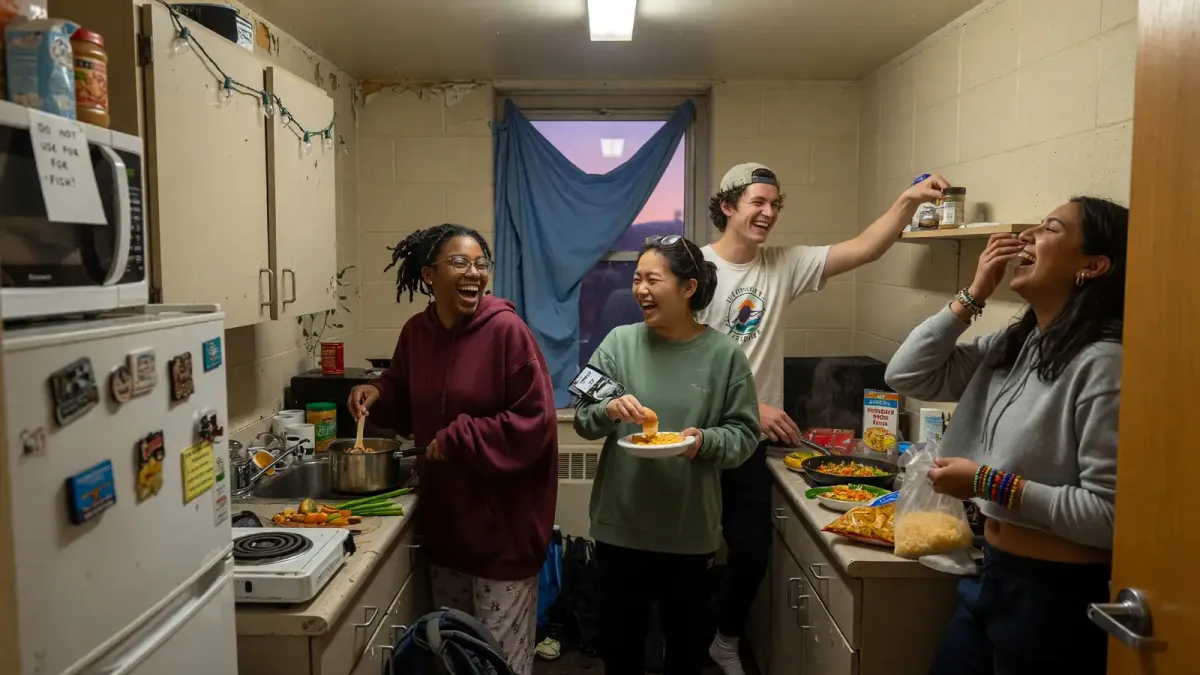
On campus, chosen family often takes shape through student organizations, residence hall communities, study groups, and the informal networks that form around shared experience. A trans student who finds two other trans students in their dorm has started a chosen family. A queer student who joins an LGBTQ+ club and starts having dinner with the same group every Thursday has built one. The structure does not need to be formal. What matters is the consistency and the choice.
The Data Behind the Difference
The California Community Colleges system invested in LGBTQ+ student success through Assembly Bill 132, and the results are instructive. After three years of programming that included study halls, mentorship, and community lunches, students reported measurable improvements in belonging and academic performance. One student put it plainly: “The study halls, mentorship, and lunches gave me a place where I could belong and be myself. That support system kept me focused, connected, and on track with my classes.”
That quote is not an outlier. It describes what the research consistently shows across institutions. When LGBTQ+ students have access to affirming peer networks, they are more likely to persist through difficult semesters, seek help when they need it, and report higher levels of life satisfaction. The mechanism is straightforward. Isolation is corrosive. Connection is protective.
The numbers back this up. A 2024 study by the Trevor Project found that LGBTQ+ youth who had at least one accepting adult in their lives were 40% less likely to report a suicide attempt in the past year. On campus, the equivalent of “one accepting adult” is often one accepting peer — someone who sees you, knows your name, and makes you feel like you matter. The bar is lower than most people think, but the impact is enormous.
Students who report having a strong chosen family also tend to engage more with campus resources. They are more likely to visit the counseling center, attend workshops, and apply for scholarships. The peer network does not replace professional support. It lowers the barrier to accessing it. When your friend says “I went to the counseling center and it was actually fine,” you are more likely to go yourself.
The GLAAD Campus Ambassador program has documented similar patterns. When students are connected to peers who share their identity and experiences, they report lower rates of anxiety and depression, higher academic engagement, and a stronger sense of purpose. The effect is not limited to students who are already well-adjusted. It is strongest for the students who arrived on campus feeling the most alone.
Why Campus Communities Are Not Enough on Their Own
Creating a chosen family is not the same as creating an LGBTQ+ resource center. Resource centers are important, but they serve a different function. A resource center provides services. A chosen family provides presence. You can use the counseling services at a resource center without knowing anyone’s name. You cannot build a chosen family that way.
The distinction matters because many campuses assume that providing resources is equivalent to building community. It is not. A student can walk into a resource center, get what they need, and leave without ever forming a meaningful connection. The student who stays, who comes back, who starts to feel like they belong, is usually the one who found a person — not a program.
This is why some of the most effective LGBTQ+ campus programs are not the ones with the biggest budgets or the fanciest spaces. They are the ones that facilitate repeated, low-stakes interactions between students. A weekly movie night. A study group that meets in the same room every week. A group chat that stays active between meetings. The magic is in the repetition and the informality. When you see the same faces every Tuesday, you stop being strangers. When you stop being strangers, you start becoming family.
Mark Berg, a leader in LGBTQ+ higher education, put it this way: “There’s an organization who cares about them … that they can find community if they’re not finding it on their campus or that they can learn from us and build community where they are.” The emphasis on “build” is deliberate. Community does not happen because an institution creates a space for it. It happens because individuals decide to show up for each other, repeatedly, over time.
Building Chosen Family When You Do Not Know Where to Start
If you arrived on campus and do not know where to begin, here are the patterns that tend to work.
Start with one recurring commitment. Not five clubs, not ten meetups, not every event on the LGBTQ+ calendar. Pick one group that meets regularly and attend it consistently for at least a month. The first few times might feel awkward. That is normal. Chosen family does not form in a single meeting. It forms when people recognize your face, learn your name, and start expecting you to be there.
Look for the informal spaces. The group that goes to the dining hall together after the meeting. The study session that happens in someone’s dorm room. The text thread where people share mundane updates about their day. These unstructured moments are where chosen family actually develops. The formal meeting is the entry point. The dinner after is where the real connection happens.
Be the person who initiates. This is especially important if you are shy or socially anxious, because the students who build chosen families fastest are usually the ones who send the first text, suggest the first coffee, and ask the first “want to hang out?” It does not need to be elaborate. A simple “I am going to the library, want to come?” is enough to start.
If you are an international student, a first-generation student, or someone who arrived on campus without knowing anyone, the task can feel even more daunting. You may not have the cultural reference points that make casual conversation easy. You may be navigating a new language, a new city, and a new identity all at once. In those cases, look for other students who are in the same position. The bond of shared newness is strong. Other international students, other first-generation students, other people who are figuring it out for the first time — those are your people, at least to start.
Accept that some relationships will not work out. Not every person you click with will become part of your chosen family. Some friendships fade. Some people are not in a place where they can show up for you the way you need. This is not a failure. It is the normal process of finding the people who fit. The students who build strong chosen families are usually the ones who keep trying after the first few attempts do not work.
What Chosen Family Looks Like in Practice
The day-to-day reality of chosen family is less dramatic than the origin stories suggest. It is the friend who texts you on a hard day because they noticed you were quiet in class. It is the person who saves you a seat without being asked. It is the group that celebrates your good grade or sits with you after a bad therapy appointment. It is the roommate who uses your correct pronouns without making a big deal about it.
It is also the harder stuff. The friend who tells you that you have been isolating yourself and asks what is going on. The person who holds you accountable when you are avoiding your responsibilities. The group that has the uncomfortable conversation about boundaries or conflict and comes out the other side still intact. Chosen family is not only about comfort. It is about people who care enough to be honest with you.
For students who have experienced family rejection, these relationships can feel unfamiliar and even frightening. Letting someone in means risking another rejection. Building trust means being vulnerable with people who have the ability to hurt you. The students who navigate this successfully usually do it gradually, testing the relationship with small acts of trust before sharing the bigger ones.
There is a particular challenge for students who are questioning their identity. You may not feel ready to join an explicitly LGBTQ+ group. You may not even be sure what your identity is yet. That is fine. Chosen family does not require a label. It requires trust. Start with the people who make you feel safe, regardless of what letters they use to describe themselves. The identity conversations can come later. The belonging comes first.
The Long Game
Chosen family is not a quick fix for the loneliness that many LGBTQ+ students feel when they arrive on campus. It takes time, effort, and a willingness to keep showing up even when it feels like nothing is happening. But the research and the lived experience both point to the same conclusion: the students who find their people are the ones who thrive.
The California Community Colleges system saw this play out over three years of investment. The students who participated in community-building programming did not just report feeling better. They stayed in school. They finished their degrees. They went on to careers and lives that might not have been possible without the support network that held them up during the hardest years.
Chosen family does not erase the pain of rejection or the challenges of being queer in a world that is still figuring out how to accept that. But it provides something that nothing else can: the knowledge that you are not alone, that there are people who choose you, and that you belong somewhere — even if that somewhere is not where you expected to find it.
Luca E. Lewis, who became the first out trans college president in 2026, built his career on this principle. He did not wait for institutions to create the community he needed. He built it himself, one relationship at a time, and eventually turned that work into leadership. His story is not typical, but the pattern is. The students who invest in building chosen family early in their college careers are the ones who carry those networks with them long after graduation. The friendships formed in a dorm room or a student club become the professional connections, the holiday dinner invitations, and the people you call when life gets hard.
Start small. Show up. Keep showing up. The family you choose will find you.