There’s a moment that changes everything. For some, it happens in a dorm room at 2 a.m., whispered to a roommate they’ve known for three weeks. For others, it’s a text message sent from the library bathroom, thumbs hovering over the send button for ten minutes. And for many, it never happens at all—not in words, anyway.
Coming out isn’t a single event. It’s a process, a conversation that repeats itself in new classrooms, with new friends, at new jobs. For LGBTQ+ students navigating college, these moments of revelation and vulnerability shape not just how others see them, but how they see themselves.
We talked to students from campuses across the country. Their stories are different—some joyful, some painful, all real. What follows are their voices, in their own words.
Marcus: “I Didn’t Want to Be ‘The Gay Kid’”
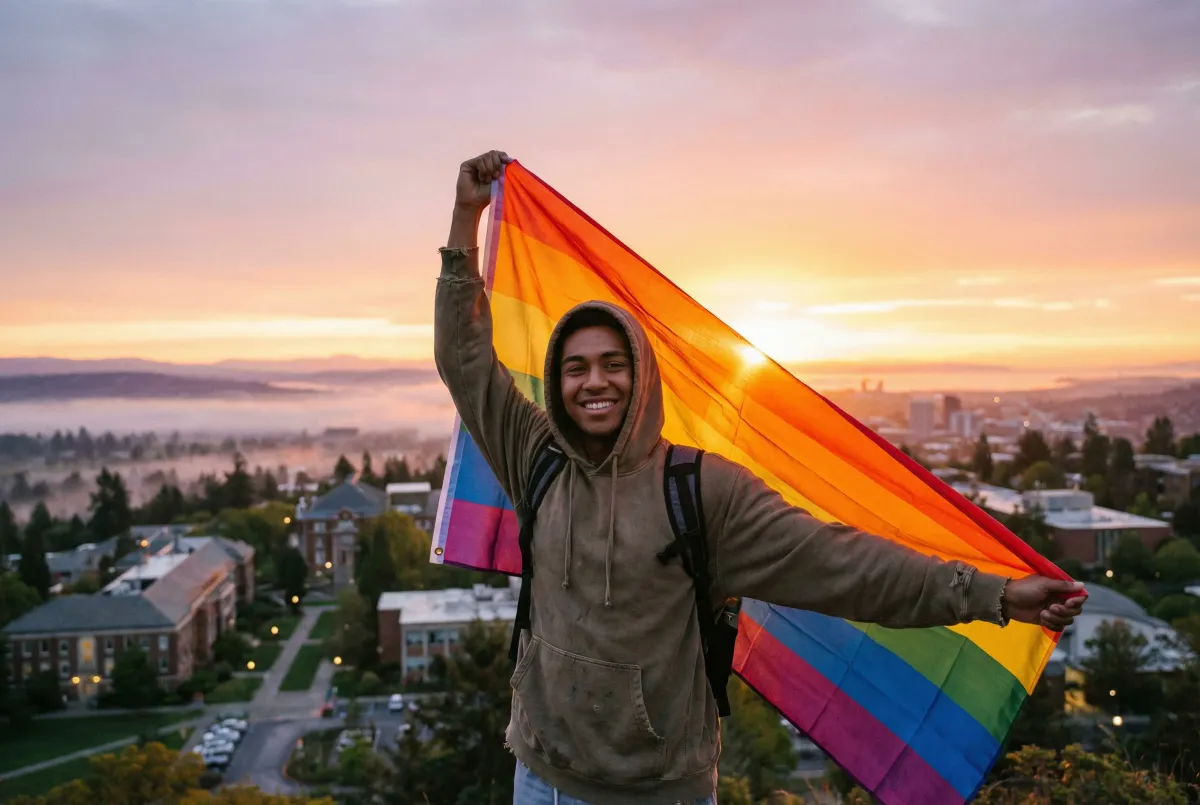
Marcus arrived at the University of Michigan freshman year with a plan: keep his head down, focus on computer science, and maybe—maybe—tell someone about himself by senior year.
“I grew up in a small town in Ohio where ‘gay’ was still something kids said when they meant ‘stupid,’” he explains. “I watched one guy in my high school come out, and it wasn’t pretty. People were ‘nice’ to his face, but you could feel the distance. I wasn’t going to let that be me.”
So Marcus built walls. He made friends with guys on his floor who talked about girls and parties and nothing that mattered too much. He went to the gym. He joined an intramural soccer team. And he spent most nights lying awake, scrolling through Reddit threads about other people’s coming out stories, wondering why he couldn’t just say the words.
The breaking point came unexpectedly. During winter break sophomore year, his roommate Jake found him crying at his desk. Not dramatic tears—just quiet, exhausted ones.
“I’d just gotten off the phone with my mom. She was asking if I’d met any nice girls, and I couldn’t do it anymore. The lying by omission. The performance. Jake didn’t say anything at first. He just sat on his bed and waited.”
What happened next surprised Marcus. Jake told him about his own sister, who’d come out as lesbian two years before. He admitted he’d been a terrible brother at first—distant, awkward—until he realized his discomfort was his problem, not hers.
“He said, ‘I don’t know what you’re going through, but you don’t have to go through it alone.’ And that was it. I told him. The words felt strange in my mouth, like speaking a language I’d only ever practiced in my head.”
Marcus didn’t become “the gay kid” after that. He became Marcus—who happens to be gay, who still plays soccer and studies computer science and makes terrible puns. But he also became someone who could breathe.
“I wasted so much energy on hiding. Looking back, I wish I’d known that the people who matter don’t care about who you love. They care about whether you show up.”
Aaliyah: “My Parents’ Love Came with Conditions”
Aaliyah’s story starts with a secret she’s kept for years. She knew she was bisexual in middle school, but she didn’t tell her Pakistani-American parents until college—and even then, she only told half the truth.
“I came out to them as ‘experimenting’ sophomore year. I thought if I made it sound temporary, less serious, they’d handle it better. My mom cried. My dad said I was confused, that I hadn’t met the right man yet. They didn’t disown me, but they made it clear this wasn’t who they wanted me to be.”
The conditional acceptance took its toll. Aaliyah found herself compartmentalizing her life in ways that felt increasingly absurd. She’d bring her boyfriend home for Eid and introduce her girlfriend to friends as her “roommate.” She performed the role of dutiful daughter while feeling like a fraud.
“There’s this extra layer for kids from immigrant families, especially South Asian ones. Your identity isn’t just yours—it belongs to your parents, your community, your entire lineage. Coming out feels like betraying centuries of tradition.”
Everything shifted during her junior year abroad in London. Away from her parents’ expectations, Aaliyah joined a queer South Asian collective. For the first time, she met people who understood both parts of her—the cultural and the queer—and didn’t see them as contradictory.
“I met this woman, Priya, who’d been out to her parents for ten years. She told me, ‘Your parents might never fully accept this part of you. But you can stop waiting for their permission to be whole.’”
Aaliyah came home from London different. She stopped hiding her girlfriend. She started correcting people who assumed she was straight. And she had a hard conversation with her parents—one where she didn’t apologize or minimize or make it easier for them.
“They’re still learning. We don’t talk about it much. But I stopped editing myself, and that’s made all the difference. I can’t control their journey. I can only live mine.”
Jordan: “Transitioning in Public”
Jordan came to Tufts University already knowing he was trans. What he didn’t know was whether he could actually transition while living in a dorm, sharing bathrooms, and introducing himself to hundreds of new people who’d only ever known him as someone else.
“I’d been out to myself for two years before college, but I was terrified of transitioning in such a public way. High school was bad enough—college felt like doing it on a stage.”
The first semester, Jordan played it safe. He used his birth name in class, wore clothes that didn’t draw attention, and avoided mirrors. But he also started going to the campus LGBTQ center, meeting other trans students who’d navigated the same fears.
“I remember this senior, Eli, who’d transitioned during his freshman year. He told me about changing his name in the system, about the professors who messed up pronouns and the ones who got it right immediately, about the relief of finally being seen. He made it feel possible.”
Jordan started small. He changed his name on Facebook. He asked his roommate to use male pronouns when they were alone. He bought his first binder and wore it under baggy sweatshirts, terrified someone would notice.
By spring semester, he was ready. He updated his name in the university system. He emailed his professors before classes started: “I use he/him pronouns and go by Jordan.” He held his breath and waited.
“Most people were fine. A few asked invasive questions. One professor kept using my old name for weeks until I finally corrected her in front of the whole class. That was mortifying. But the thing I didn’t expect? How normal it started to feel. How quickly ‘Jordan’ stopped feeling like a costume and started feeling like me.”
Two years later, Jordan works at that same LGBTQ center where he found Eli. He helps other trans students navigate name changes, housing accommodations, and the exhausting bureaucracy of being yourself.
“I tell them what Eli told me: the hardest part isn’t other people. It’s believing you deserve to take up space as your real self. Once you believe that, everything else is just logistics.”
Zara: “I Thought I Was Broken”
Zara’s journey to understanding herself took longer than most. Through high school and her first two years of college, she dated men because that’s what she thought she was supposed to do. The relationships never felt right, but she blamed herself—her pickiness, her independence, her “commitment issues.”
“I didn’t know asexuality was a thing. I literally had no framework for it. Every movie, every book, every conversation with friends assumed sexual attraction was this universal human experience. Since I didn’t feel it, I assumed I was broken or repressed or just hadn’t met the right person.”
Her awakening came from an unlikely source: a Tumblr post about aromanticism that a friend shared. Zara read it three times, feeling something shift in her chest. She spent the next six months devouring everything she could find about asexuality and aromanticism, crying with relief and grief in equal measure.
“Relief because finally there was a word for what I was. Grief because I’d spent so long hating myself for something that wasn’t wrong with me at all.”
Coming out as aroace (aromantic and asexual) presented unique challenges. Some friends dismissed it as “not a real orientation.” Family members suggested she see a doctor. Even in LGBTQ spaces, she sometimes felt invisible—her identity defined by absence rather than presence.
“The hardest conversation was with my mom. She kept asking, ‘But will you be happy?’ Like a life without romance or sex was automatically a life without joy. I had to explain that my happiness looks different than hers, and that’s okay.”
Zara found her community in an asexual student group on campus, where she met others who understood the specific loneliness of being ace in a hypersexual culture. Together, they navigate a world that constantly tells them they’re missing out on the most important human experience.
“People think being aroace means being alone. But I have deep, meaningful friendships. I have passions and ambitions. I have a rich inner life. I just don’t experience attraction the way most people do, and I’m finally okay with that. Better than okay—I’m proud of it.”
Finding Common Ground
These stories are different in their details, but they share something essential. Each student faced a moment—many moments—where they had to choose between the safety of hiding and the risk of being seen. Each found that the cost of hiding was higher than they could keep paying.
College creates a unique window for this kind of self-discovery. For many students, it’s the first time they’re living away from family expectations, surrounded by people who don’t know their history. That freedom can be terrifying and liberating in equal measure.
The data tells part of this story. A 2024 Gallup poll found that 9.4% of American adults now identify as LGBTQ+, with the number doubling since 2020. Among Gen Z, that percentage is significantly higher. College campuses are becoming increasingly queer spaces—not because more people are “becoming” LGBTQ+, but because more people feel safe enough to say it out loud.
But safety isn’t automatic. LGBTQ+ students still face real challenges: anti-trans legislation that threatens their healthcare, DEI rollbacks that eliminate support services, harassment and discrimination that too often goes unaddressed. The students who shared their stories here are the lucky ones—they found communities that affirmed them, even when the broader culture didn’t.
For those still searching, there are resources. Campus LGBTQ centers, student organizations, online communities, and hotlines like The Trevor Project offer support and connection. Sometimes the most radical act is simply finding someone else who understands.
What Comes Next
If you’re reading this and seeing yourself in these stories, know that you’re not alone. The journey of self-acceptance isn’t linear. There will be days when you feel completely at home in yourself, and days when you question everything. Both are normal.
If you’re an ally—someone who loves an LGBTQ+ student, who shares a dorm or a classroom or a family with them—the best thing you can do is listen without agenda. Don’t ask invasive questions. Don’t make their identity about your discomfort. Just show up, consistently and without fanfare.
The students we spoke with all said versions of the same thing: coming out didn’t fix everything. It didn’t erase their struggles or guarantee acceptance. But it gave them something more valuable than certainty—it gave them the chance to be whole.
Marcus put it best: “I spent so long thinking I had to choose between being gay and being myself. Turns out they’re the same thing. And I’m finally learning to like who that is.”
If you need support, please reach out to your campus LGBTQ center, counseling services, or contact The Trevor Project at 1-866-488-7386 or thetrevorproject.org.