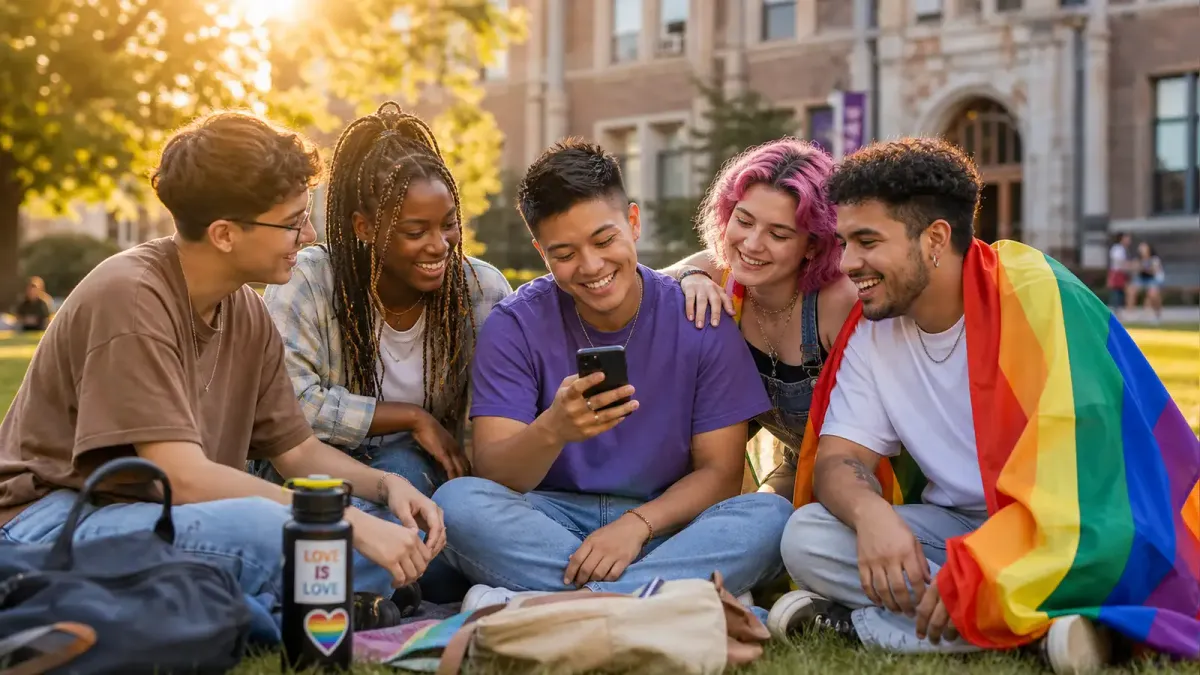
It’s 2 a.m. and you’re in bed, phone in hand, thumb moving on autopilot. You started by checking a group chat about this weekend’s Pride event on campus. Then you saw a news alert about another state passing anti-LGBTQ+ legislation. Then a TikTok from a queer creator you follow, then the comments section — where strangers are debating whether people like you deserve to exist. You meant to put the phone down an hour ago. Now you’re wide awake, heart racing, and tomorrow’s 9 a.m. lecture feels impossibly far away.
If this scenario sounds familiar, you’re living what researchers call the “double-edged sword” of digital life for LGBTQ+ young people. And you are far from alone.
The Numbers Behind the Screen
The relationship between LGBTQ+ students and social media is uniquely intense. According to the Digital Wellness Lab at Boston Children’s Hospital, LGBTQ+ youth consistently report both more positive and more negative online experiences compared to their cisgender and heterosexual peers. Social media isn’t just entertainment for this community — it’s often survival infrastructure.
A 2024 study published in Computers in Human Behavior found that approximately 70% of LGBTQ+ adolescents had access to identity-affirming spaces online, compared to just 50% at school and 34% at home. When the physical world doesn’t affirm who you are, the digital world becomes the place where you find your people.
The Trevor Project’s research confirms this pattern: roughly 80% of LGBTQ+ young people report feeling safe and understood in at least one online space, and those who don’t have that experience show significantly higher rates of anxiety, depression, and suicidal ideation. A 2025 study from Hopelab put the contrast in stark terms: 44% of LGBTQ+ young people feel “very safe” in online spaces, versus just 9% who feel that way in person.
For LGBTQ+ college students specifically — many of whom are navigating independence, identity, and community for the first time — the stakes are even higher. Campus may be more accepting than a hometown, but it’s not automatically affirming. Queer student organizations might be small, underfunded, or nonexistent. Online communities fill the gap.
When the Lifeline Becomes a Landmine
The problem, of course, is that the same platforms that connect LGBTQ+ students to community also expose them to an unrelenting stream of distress.
In May 2026, the California Assembly held an informational hearing titled “The Impact of Social Media on LGBTQ+ Youth,” developed in collaboration with the California Legislative LGBTQ Caucus. The background paper presented at that hearing identified two primary risk factors that make social media uniquely hazardous for LGBTQ+ young people: exposure to harmful content and excessive or compulsive use.
Anti-LGBTQ+ content is algorithmically amplified. A student searching for resources about coming out or gender-affirming care can, within a few swipes, land on content designed to delegitimize their identity. Comments sections on queer content are regularly flooded with harassment. And even when the content itself is affirming, the sheer volume of distressing news — another anti-trans bill, another pride event canceled, another hate crime — creates what mental health professionals recognize as chronic ambient stress.
Then there’s doomscrolling: the compulsive consumption of negative news that leaves you feeling helpless but unable to stop. For LGBTQ+ students, doomscrolling carries a particular weight because the news isn’t abstract. Those policies affect your healthcare access, your ability to update your ID, whether your partner can visit you in a hospital. The algorithm knows you care, and it feeds you more.
The Trevor Project’s 2025 U.S. National Survey on the Mental Health of LGBTQ+ Young People found that 36% of LGBTQ+ young people seriously considered suicide in the past year — 40% for transgender and nonbinary youth. While social media is not the cause, researchers note that anti-LGBTQ+ rhetoric and policies encountered online are significant contributors to these mental health outcomes. For young people who don’t feel safe or understood anywhere on the internet, the rates are even higher.
Not About Quitting — About Choosing
Here’s what this article is not going to tell you: delete all your apps and go live in a cabin. For most LGBTQ+ students, that’s neither realistic nor desirable. Online communities provide genuine value — mentorship from older queer adults, information about navigating healthcare and legal systems, friendships with people who share your identities, and access to queer culture and history that may not exist in your curriculum.
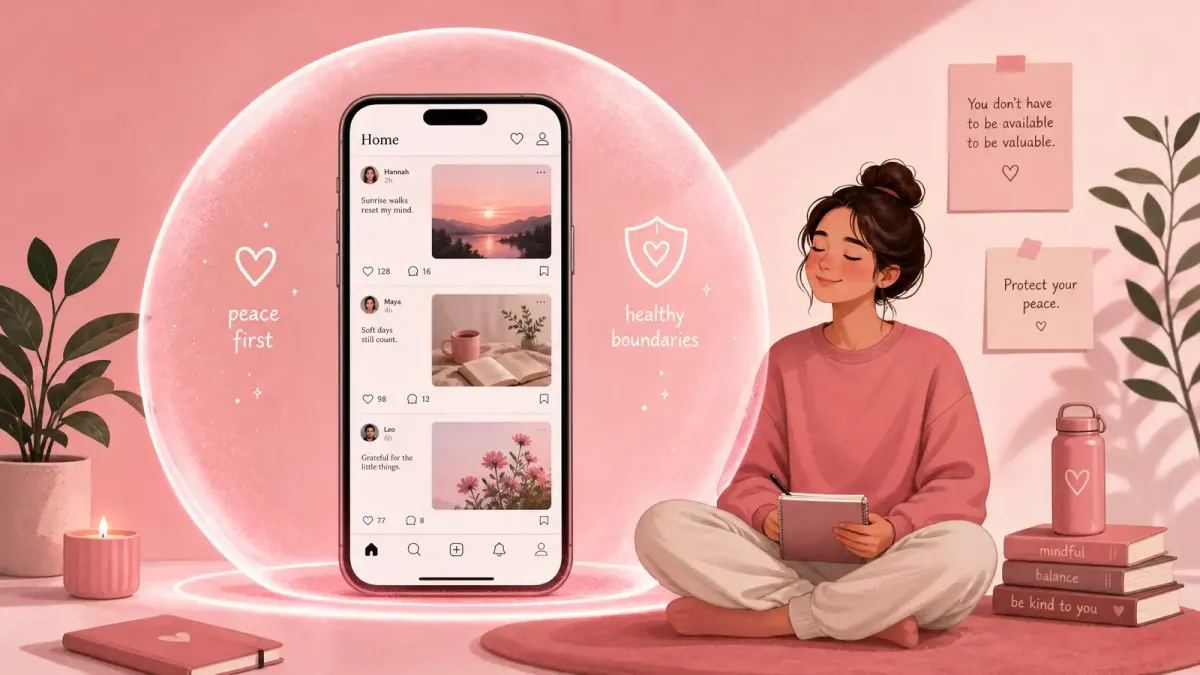
The goal of digital wellness isn’t digital abstinence. It’s digital intention.
“Digital boundaries are intentional limits you set around when, how, and why you use technology to protect your time, attention, and mental health,” explains a 2026 guide from Alma, a mental health platform. The key word is intentional. Most of us don’t decide to open Instagram; we just do it, reflexively, in the five-second gap between tasks. Reclaiming agency over that reflex is the foundation of digital wellness.
Building Your Digital Wellness Toolkit
1. Audit Your Feed Like Your Mental Health Depends on It (Because It Does)
Open each social media platform you use and spend ten minutes scrolling — but this time, pay attention to how each piece of content makes you feel. Energized? Connected? Informed? Or anxious, angry, and drained?
The accounts and topics that consistently fall into the second category need to go. Unfollow. Mute. Block. You are not obligated to witness every injustice in real time to be a good community member. Curating your feed is not burying your head in the sand — it’s recognizing that you can’t pour from an empty cup.
Replace some of what you remove with content that genuinely nourishes you. Follow queer artists, comedians, historians, gardeners, bakers, athletes. Seek out creators who share your identities and also share joy, creativity, and everyday life. Representation doesn’t only mean seeing struggle; it also means seeing thriving.
2. Create Scroll-Free Zones and Times
Pick one physical space and one time window where your phone doesn’t go. The bedroom is a powerful choice — charging your phone outside the room overnight eliminates the 2 a.m. doomscroll and improves sleep. If that feels too extreme, start with a smaller commitment: no phone during meals, or the first thirty minutes after waking up.
Time-boxing your social media use is another effective strategy. Many phones now have built-in tools that let you set daily time limits per app. The goal isn’t to hit the limit every day; it’s to notice when you’re approaching it and ask yourself: “Do I actually want to be here right now, or am I just scrolling because I’m bored, anxious, or avoiding something?”
The Virginia Tech Student Affairs office, addressing college students directly, frames it this way: “What if instead of shaming ourselves and others for phone use, we focused on building our digital well-being?” The shift from shame to curiosity is crucial. You’re not weak for finding social media compelling — these platforms are engineered by teams of experts to hold your attention. The question is whether the attention they’re holding belongs to you or to them.
3. Choose Your Platforms Strategically
Not all online spaces affect LGBTQ+ students the same way. The Trevor Project’s research on LGBTQ+ young people of color in online spaces found that TikTok is the leading platform where young people feel safe and understood (53%), followed by Discord (42%), Instagram (41%), and YouTube (33%). Each platform has a different culture, different privacy settings, and different levels of exposure to strangers.
Discord servers, for example, often function as semi-private communities with moderators and shared norms — very different from the algorithmic fire hose of Twitter/X or the public square of TikTok comments. Reddit communities organized around specific identities or interests can provide focused support without the infinite scroll design of other platforms.
Consider which platforms actually serve you. You don’t need to maintain a presence everywhere. One deeply affirming Discord server may be worth more for your mental health than passive scrolling across five different apps.
4. Learn to Recognize the Doomscroll Spiral — And Interrupt It
Doomscrolling has a physical signature. Your shoulders tense. Your breathing becomes shallow. You might feel a tightness in your chest or a knot in your stomach. Time distorts — what felt like five minutes was actually forty-five.
The Crisis Text Line recommends checking in with yourself before, during, and after scrolling. Ask: “What am I looking for right now? Connection? Information? Distraction? Am I finding it, or am I just getting more agitated?”
When you notice you’re in a doomscroll spiral, interrupt the pattern physically. Put the phone face-down. Stand up. Walk to another room. Splash cold water on your face. The physical interruption breaks the trance more effectively than willpower alone.
If you’re consuming distressing LGBTQ+ news and feel overwhelmed, the Crisis Text Line offers free, 24/7 support — text CONNECT to 741741 to chat with a trained volunteer crisis counselor. The Trevor Project also provides 24/7 crisis support for LGBTQ+ young people via phone, text, and chat at thetrevorproject.org.
5. Cultivate Offline Connections That Rival the Online Ones
The most effective digital wellness strategy is making your offline life rich enough that you don’t need to escape into your phone. This isn’t easy — especially for LGBTQ+ students on campuses with limited queer community. But it’s worth investing in.
Attend your campus Pride center’s events, even the small ones. Join an LGBTQ+ student organization, or start one if it doesn’t exist. Look for queer-friendly spaces beyond explicitly LGBTQ+ clubs: an affirming professor’s office hours, a campus coffee shop that hosts open mic nights, an intramural sports team with inclusive policies.
The goal isn’t to replace online community with offline community — it’s to have both. Online spaces are uniquely good at connecting you with people who share very specific, marginalized identities. Offline spaces are uniquely good at providing the embodied presence, eye contact, and physical safety that screens cannot replicate. You deserve access to both.
6. Protect Your Privacy Without Apology
For LGBTQ+ students who aren’t out in all contexts — to family, hometown friends, or employers — digital privacy is a safety issue, not a preference. Use platform privacy settings intentionally. Consider maintaining separate accounts for different audiences if needed. Be thoughtful about what personal information you share in public forums, especially if it could be screenshotted and shared beyond your intended audience.
Many colleges now include digital privacy in their LGBTQ+ resource center programming, recognizing that online exposure can have real-world consequences for students whose families or communities are not affirming. If your campus has an LGBTQ+ center, ask what resources they offer around digital safety and privacy. If they don’t yet, the request itself plants a seed.
A Final Word on Self-Compassion
You will not do all of this perfectly. You will have nights where you scroll until 3 a.m. watching a legislative hearing that makes you furious. You will have days where you open the same app twelve times in an hour because you’re lonely and it’s the quickest way to feel connected. That doesn’t mean you’ve failed at digital wellness. It means you’re human, navigating an environment designed to exploit your attention and your identity simultaneously.
Digital wellness is not a destination you arrive at. It’s a practice you return to, over and over, with as much gentleness as you can muster. For LGBTQ+ students, the internet is genuinely complicated terrain — simultaneously more necessary and more treacherous than it is for your non-LGBTQ+ peers. Treating yourself with compassion as you learn to navigate it is not optional. It’s the whole point.
The communities you’ve found online are real. The friendships, the validation, the information — none of that is fake just because it arrived through a screen. The goal of digital wellness isn’t to reject those gifts. It’s to receive them without also absorbing the harm that travels alongside them. It’s to scroll, post, and connect on your own terms — not the algorithm’s.
Start small. Pick one strategy from this guide and try it for a week. Notice what changes, and what doesn’t. Your digital life should feel like a home you’ve furnished yourself, not a room someone else locked you into. You have more control than it feels like. And you’re worth the effort it takes to exercise it.