LGBTQ+ Friendly Dorm Guide 2026: How to Choose Your Campus Home
Your dorm should be your sanctuary—a place where you can rest, study, and be yourself without fear. For LGBTQ+ students, finding safe housing isn’t just about comfort. It’s about safety, mental health, and belonging.
This guide covers everything you need to know about LGBTQ+-friendly housing in 2026, from gender-inclusive policies to application strategies.
What Is Gender-Inclusive Housing?
Definition & Basics
Gender-Inclusive Housing (GIH) allows students of any gender to live together in the same room, suite, or floor. Unlike traditional housing that assigns rooms based on binary sex categories (male/female), GIH recognizes that:
- Gender exists beyond the binary
- Students should choose who they share space with
- Safety and comfort matter more than outdated norms
Why GIH Matters
The statistics tell a sobering story:
- 24% of transgender students report experiencing harassment at school
- LGBTQ+ students are more likely to feel unsafe in residence halls
- Housing insecurity affects LGBTQ+ youth at higher rates than their peers
Gender-inclusive housing isn’t a “special treatment.” It’s about creating options that keep students safe and supported.
A Brief History
- 2003: Wesleyan University becomes one of the first to offer gender-inclusive housing
- 2010s: Rapid expansion—over 470 colleges now offer some form of GIH
- 2024: 49 out of 50 states have at least one school with gender-inclusive options
- 2025-2026: Policy rollbacks in some states create new challenges
The Current Landscape: 2026 Reality Check
Growth and Progress
Despite political challenges, gender-inclusive housing has grown significantly:
National Statistics:
- 470+ colleges offer gender-inclusive housing
- Majority of Ivy League schools have robust GIH policies
- Large public universities increasingly adopting inclusive policies
- Small liberal arts colleges often lead in innovation
Policy Challenges Under the Trump Administration
Executive Order Impact: In early 2025, federal guidance shifted to recognize only two genders. This affected:
- Federal forms and documentation
- Schools receiving federal funding
- Title IX interpretations
State-Level Restrictions:
- North Carolina: University system banned gender-neutral housing
- Idaho: Considered legislation to prohibit GIH
- 15 states: Restrict transgender people from using facilities matching their gender identity
- Florida & Utah: Prohibited gender-inclusive housing at university level
School Responses
Some Schools Retreated:
- University of Kansas: Reverted to gender-segregated housing in 2025, citing building code compliance
- Several Texas schools: Reduced visible LGBTQ+ programming
- Some Florida universities: Eliminated DEI offices entirely
Others Held Strong:
- Harvard University: Maintained open GIH policy for all students
- University of California system: Expanded transgender protections
- Many private institutions: Refused to self-censor
Key takeaway: Policy varies dramatically by state and institution type. Research your specific school carefully.
Types of LGBTQ+ Housing Options
1. Gender-Inclusive Rooms
What it is: Any students can share a room regardless of gender identity or sexual orientation.
Who it’s for:
- Couples (including same-gender couples)
- Friends of different genders
- Nonbinary students seeking flexible options
Common at:
- Upper-class housing
- Apartment-style residences
- Schools with “open housing” policies
2. Gender-Inclusive Floors/Suites
What it is: Entire floors or suite complexes where any gender can live together.
Features:
- Shared bathrooms within the floor/suite
- Community lounge spaces
- Often includes programming and events
Who it’s for:
- Students seeking community
- Those who want flexibility without living in a single room
- Groups of friends with diverse genders
3. LGBTQ+ Theme Housing
What it is: Dedicated residential communities for LGBTQ+ students and allies.
Features:
- Programming focused on queer experiences
- Community dinners and events
- Faculty/staff affiliates
- Sometimes includes dedicated staff
Examples:
- West Virginia University: “True Colors” community
- University of Michigan: Spectrum Center housing
- Indiana University: Global & Inclusive Living Community
Who it’s for:
- Students wanting explicit LGBTQ+ community
- Allies who want to learn and support
- Those seeking structured programming
4. Gender-Affirming Housing
What it is: Housing specifically designed for transgender and nonbinary students.
Features:
- Private rooms (often with private bathrooms)
- Priority placement for trans students
- Staff trained in transgender issues
- Connection to trans resources
Examples:
- Tulane University: Gender-affirming housing program
- Cal Poly: Trans-inclusive housing options
- Northwestern University: Gender identity housing
Who it’s for:
- Transgender students prioritizing safety
- Nonbinary students seeking understanding roommates
- Those needing specific accommodations
How to Research Your School’s Housing Options
Step 1: Check the Housing Website
Search terms to use:
- “Gender-inclusive housing [your school name]”
- “Identity-based housing [your school name]”
- “LGBTQ+ housing options [your school name]”
- “Gender-neutral rooms [your school name]”
What to look for:
- Application forms with gender options beyond M/F
- Explicit mentions of LGBTQ+ or gender-inclusive housing
- Information about roommate selection processes
- Bathroom configurations (private, shared, all-gender)
Step 2: Contact Key Offices
Reach out to:
- Housing & Residence Life Office: Ask about GIH options
- LGBTQ+ Student Center: Get insider knowledge
- Disability Resource Office: If you need accommodations
- Title IX Office: Understand your rights
Sample email template:
Subject: Question About Gender-Inclusive Housing Options
Dear [Housing Office],
I’m an incoming/returning student interested in learning about gender-inclusive housing options on campus. Could you please share information about:
- Whether gender-inclusive housing is available
- Who is eligible to apply
- Application deadlines and process
- Bathroom and facility arrangements
Thank you for your time and assistance.
Best regards, [Your name]
Step 3: Ask Current Students
Where to find them:
- LGBTQ+ student organization social media
- Reddit (r/[yourschool])
- Discord servers
- Campus visit events
Questions to ask:
- “How supportive is housing staff?”
- “Are RAs trained on LGBTQ+ issues?”
- “Have you experienced issues with roommates?”
- “Would you recommend GIH at this school?”
Key Questions to Ask Before Applying
Eligibility & Access
-
Who can apply for gender-inclusive housing?
- Open to all students?
- Priority for trans/nonbinary students?
- Requires demonstration of need?
-
Is it available for first-year students?
- Some schools restrict to upperclassmen
- Some require living in traditional housing first year
-
Can I choose my roommates?
- Self-selection allowed?
- School matching process?
- Combination approach?
Application Process
-
What’s the application timeline?
- Standard housing deadline?
- Separate GIH application?
- Rolling admission or fixed date?
-
Are there additional requirements?
- Essays or statements?
- Interviews?
- Meetings with staff?
-
How does roommate matching work?
- Online profile system?
- Direct contact before committing?
- Ability to request specific roommates?
Facilities & Support
-
What are the bathroom arrangements?
- Private bathrooms?
- Shared within floor?
- All-gender facilities?
-
What training do staff receive?
- RA training on LGBTQ+ issues?
- Professional staff oversight?
- Reporting mechanisms for problems?
-
How are conflicts handled?
- Room change policies?
- Mediation processes?
- Emergency relocation options?
Application Timeline & Process
For Incoming First-Year Students
Fall (Before Senior Year):
- Research housing options at target schools
- Include housing preferences in college applications
- Note: Some schools require admission before housing application
Spring (Senior Year):
- March-April: Housing applications open
- May-June: Submit housing deposit
- June-July: GIH applications typically due
- July-August: Room assignments sent
Important: GIH deadlines may differ from general housing. Mark your calendar!
For Transfer Students
Varies by school:
- Some offer rolling admission for housing
- Others have specific deadlines
- Contact housing office early in application process
For Returning Students
Typically:
- February-March: Room selection period
- April-May: GIH applications for next year
- End of spring semester: Assignments made
Roommate Selection Strategies
Using School Matching Systems
Many schools use questionnaires to match roommates:
Tips for success:
- Be honest about your identity and needs
- Note dealbreakers (smoking, guests, cleanliness)
- Indicate openness to LGBTQ+ roommates if important
- Follow up with potential matches before committing
Finding Your Own Roommates
Best practices:
- Use LGBTQ+ student group Facebook groups
- Connect through orientation programs
- Ask friends for recommendations
- Have explicit conversations about expectations
Conversation Starters
Before committing to live together:
“I want to make sure we’re compatible roommates. Can we talk about:”
- “Pronouns and how we’ll use them”
- “Guest policies, especially for partners”
- “Privacy expectations”
- “How we’ll handle conflicts”
- “Study/sleep schedules”
Red flags to watch for:
- Hesitation about using correct pronouns
- Dismissive comments about LGBTQ+ topics
- Unwillingness to discuss boundaries
- History of conflicts with previous roommates
Living Well: Practical Tips for Dorm Life
Communication With Roommates
Early Conversations (First Week):
- Share pronouns and ask for theirs
- Discuss visitor policies
- Talk about privacy needs
- Set up regular check-ins
Ongoing Communication:
- Weekly or monthly roommate meetings
- Address issues early, before they escalate
- Use “I” statements: “I feel…” not “You always…”
- Celebrate successes together
Handling Problems
Minor Issues (Misgendering, Forgetfulness):
- Gentle correction: “Actually, I use they/them pronouns”
- Assume good intent initially
- Offer resources if they’re receptive
Serious Issues (Harassment, Discrimination):
- Document incidents (date, time, what happened)
- Report to RA or residence life coordinator
- Contact LGBTQ+ center for support
- Request room change if needed
Emergency Situations:
- Contact campus security if unsafe
- Reach out to Title IX office for discrimination
- Connect with crisis counseling services
Building Community
Ways to Connect:
- Attend floor events
- Join LGBTQ+ student organizations
- Participate in residence hall programming
- Create informal study groups or meals
Creating Your Own Space:
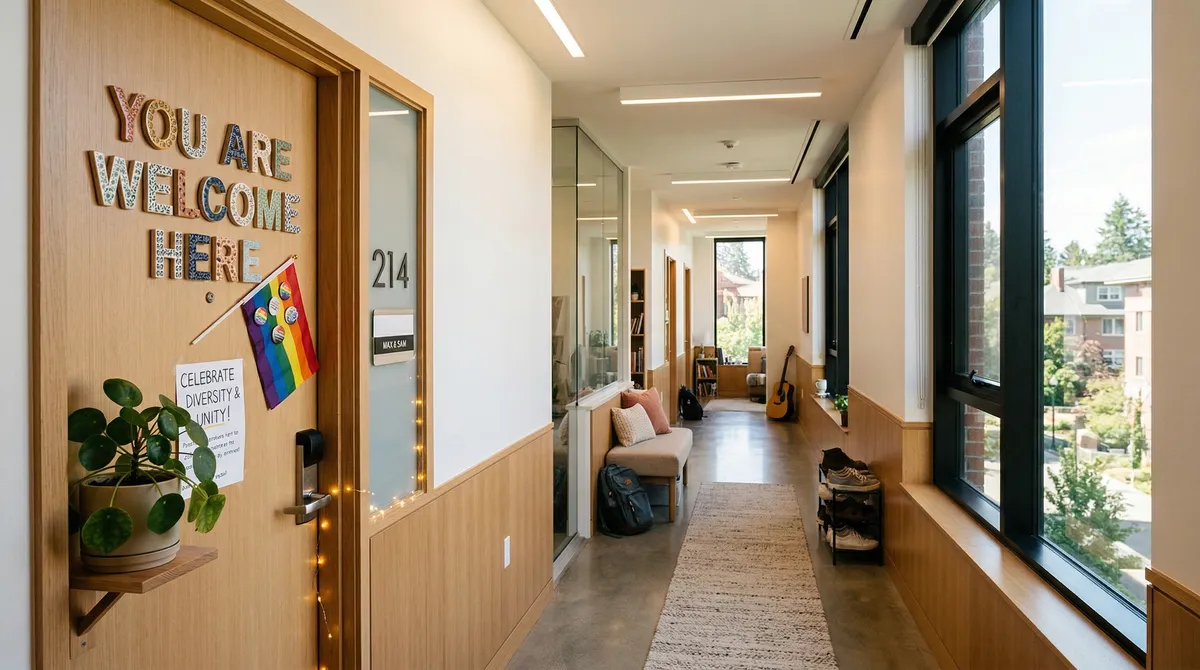
- Decorate with affirming items (pride flags, photos)
- Set boundaries about who can enter your space
- Find quiet spaces on campus when you need alone time
Beyond Campus: Alternative Housing Options
Off-Campus Housing
Pros:
- More control over who you live with
- Potentially more affordable
- Not subject to dorm policies
- Greater privacy
Cons:
- Commute time to campus
- Lease commitments
- Further from campus resources
- Need to vet landlords/roommates
Tips for off-campus success:
- Research neighborhood LGBTQ+ friendliness
- Meet potential roommates multiple times
- Read lease carefully before signing
- Know your tenant rights
Cooperative Housing
What it is: Student-run housing where residents share responsibilities.
Features:
- Democratic decision-making
- Shared chores and meals
- Often more progressive/inclusive
- Lower costs than traditional housing
Find co-ops: Search “student housing cooperative [your city]“
LGBTQ+-Specific Housing
Some cities have LGBTQ+-friendly housing options:
- San Francisco: LGBT Community Center housing resources
- Chicago: Center on Halsted housing assistance
- New York: The Ali Forney Center (for youth)
Special Considerations
For Transgender Students
Additional factors to consider:
Bathroom & Shower Access:
- Are there private options?
- Can you use facilities matching your gender identity?
- What’s the policy for shared spaces?
Name & Pronoun Updates:
- Can housing records reflect your chosen name?
- How does this connect with campus directories?
- What if your legal name differs?
Medical Needs:
- Storage for hormones/medications
- Access to gender-affirming supplies
- Proximity to health services
For Nonbinary Students
Advocating for Inclusion:
- Request all-gender bathroom access
- Ask for gender-neutral room assignments
- Connect with other nonbinary students for support
Your Rights:
- Many schools now recognize nonbinary options
- Title IX increasingly protects gender identity
- You deserve respectful treatment
For International LGBTQ+ Students
Unique Challenges:
- Visa requirements may tie you to campus housing
- Cultural differences in understanding LGBTQ+ identities
- Distance from home support systems
Resources:
- International student office
- LGBTQ+ center (many have specific programming)
- Country-specific LGBTQ+ organizations
Your Rights as an LGBTQ+ Student
Federal Protections
Title IX:
- Prohibits sex discrimination in education
- Courts have increasingly recognized gender identity protection
- Note: Protections vary by administration
Fair Housing Act:
- Some courts interpret sex discrimination to include gender identity
- Applies more to off-campus housing
State Protections
Varies significantly:
- Protective states: CA, NY, MA, WA, CO, etc. have explicit protections
- Limited states: Some have no explicit LGBTQ+ housing protections
- Restrictive states: Some actively limit protections
Research your state: Lambda Legal and ACLU track state laws
Campus Policies
Review:
- Non-discrimination policies
- Student code of conduct
- Housing-specific policies
- Complaint procedures
Know the process:
- How to file complaints
- Timeline for resolution
- Available remedies
Resources & Support
Campus Resources
- LGBTQ+ Student Center
- Housing & Residence Life Office
- Counseling Services
- Title IX Office
- Ombuds/Mediation Services
National Organizations
Campus Pride: campuspride.org
- Campus climate ratings
- Housing policy information
- Student leadership programs
Lambda Legal: lambdalegal.org
- Legal rights information
- Know Your Rights resources
- Legal help desk
ACLU LGBTQ+ Rights: aclu.org/lgbtq-rights
- Policy advocacy
- Legal resources
- State-by-state information
Transgender Law Center: transgenderlawcenter.org
- Legal resources for trans students
- Policy guidance
- Know Your Rights materials
Housing-Specific Resources
Genny Beemyn’s Research: gennyb.com
- Comprehensive list of schools with gender-inclusive housing
- Updated regularly
- Includes policy details
Final Thoughts: Finding Your Place
You Deserve Safe Housing
Safe, affirming housing isn’t a luxury—it’s a basic need that affects your:
- Mental health
- Academic success
- Physical safety
- Sense of belonging
Don’t Be Afraid to Advocate
Remember:
- You have the right to ask questions
- You deserve respectful treatment
- Persistence often pays off
- Allies exist to support you
If Your School Lacks Options
Consider:
- Single rooms (if available)
- Living with affirming friends
- Off-campus housing
- Transferring to a more inclusive school
Your safety matters more than any single institution.
A Message of Hope
Thousands of LGBTQ+ students successfully navigate housing every year. You will find your people. You will create your space. You will belong.
You deserve a place to call home.
Need immediate help? Contact The Trevor Project at 1-866-488-7386 or your campus crisis line.