Southern Illinois University put a theme on October. “Queerstory in the Making.” The Paulette Curkin Pride Resource Center is running the month, and the namesake is on the kickoff program. The same day, Colgate’s student paper interviewed Lyosha Gorshkov, director of LGBTQ+ initiatives since 2021, who still does not have a Pride Center. Resources up 20% from 2022 to 2026. The building did not appear.
We already wrote that UND’s tenth year was a room and that Howard’s homecoming is a calendar. This week is the split those two stories were pointing at. A month is programming. A center is a door.
SIU named the present tense
Juniper Oxford, coordinator of the Paulette Curkin Pride Resource Center, told SIU News the theme is a departure. Previous years leaned on archive. This year they are “recognizing the historicity of the current moment” and how it lands on campus. That sentence is doing work. History Month often becomes a poster of the past so the present can stay vague. Oxford is refusing the poster.
The title change is smaller and easier to miss. They added IA — intersex and asexual — after using those inclusions in other programming for a couple of years. Oxford’s line is that those communities have been left out of the dialogue. A title is not a clinic. It is a signal about who the month thinks it is for. If your campus still prints “LGBT” on the October banner, SIU just dated that banner.
The month is not a single lecture. SIU News lists collaborations with the Black Resource Center, the Hispanic/Latino Resource Center, Veterans Services, Counseling and Psychological Services, and student organizations. That is the boring infrastructure that makes a theme real. A Pride office that cannot name its partners is running a reception.
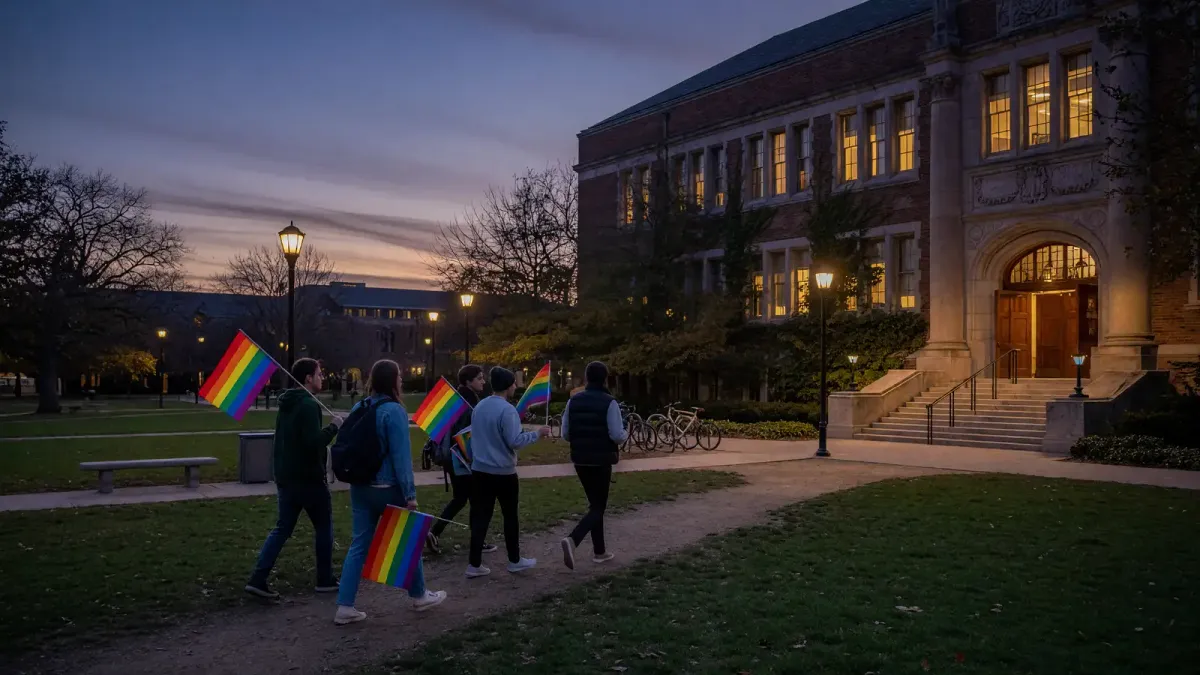
Kickoff was Thursday, October 1. Saluki Rainbow Network’s Pride flag march starts at 6:30 p.m. in front of the Communications Building and walks to the library. Paulette Curkin speaks at 7 p.m. in Morris Library’s third-floor rotunda. Refreshments. The founder in the building named after her is not subtle, and it should not be. Campuses that borrow a dead activist’s name for a PDF should look at this schedule.
The rest of October, still according to SIU: a panel, Intersex Awareness Day, a craft workshop, a costume dance, a Safe Zone retreat. The complete grid lives on the Pride Resource Center site. If you are not at Carbondale, steal the shape, not the mascot. A march, a named speaker, a Safe Zone block, and at least one day that is not about gay men in the 1970s.
The Southern’s write-up of the same announcement is useful as a check that this was not an internal newsletter. Local coverage means parents and alumni saw it. A History Month that never leaves the Center’s Instagram is a club calendar.
Colgate is doing the work in other people’s rooms
Gorshkov has had the director title since 2021. Colgate does not have a traditional Pride Center. He works out of other spaces, including the Center for Women’s Studies and the ALANA Cultural Center. His quote is the whole small-campus condition: “You intertwine, on small campuses in particular, with other offices. You build natural connections with other departments, which helps students navigate their experiences.”
That is true and it is also a workload. Students still have to know which borrowed room is the right one on a given day. A Women’s Studies lounge is not automatically a trans housing conversation. An ALANA cultural center is not automatically a Pride library. Intertwining is how you survive a missing line item. It is not the same as a door with hours.
He puts the campus LGBTQ+ population at about 4%. He points at student organizations, the Pink House, and the people who show up. He credits Colgate policy, DEI commitments, and gender-affirming care through Student Health Services. Those are real services. They are also easy to over-count as “a center.” Health Services is a clinic. A Pride Center is a place you can sit without a diagnosis.
The 20% increase in LGBTQ+ resources from 2022 to 2026 is Gorshkov’s number, and he calls it humbling because it is many people’s work. Do not turn it into a facilities claim. Percentage of “resources” can mean a webpage, a training, a liaison, a budget line, or a staff FTE. Ask which. A 20% bump that still leaves you without a center is how administrations announce progress at the same meeting where they table the space request.
Athletics is the part of the interview that will get screenshotted. Gorshkov has been putting LGBTQ+ education in front of teams. He calls the men’s hockey team a role model and says he is learning from those interactions how people support each other. That is a campus-life story, not a branding story. If the hockey locker room is more fluent than the residence hall staff, the programming calendar is inverted.
He also says homophobia and microaggressions continue. Keep that sentence next to the 20%. A resource list does not retire the rest of the week.
A calendar is not a door
Colorado State’s October roundup treats the month as one more block on a university events page. That is how most campuses will experience October: a grid. Homecoming, midterms, a film, a history month, a career fair. We already watched Temple’s move-in form send a student home in a week that had plenty of rainbow graphics. The form is the policy. The calendar is the decoration.
SIU’s advantage is that a named center owns the grid. Oxford can add IA to the title, book Curkin, and pull Veterans Services into the same month because there is a coordinator whose job is that coordination. Colgate’s advantage is a director who will walk into the hockey offices. The gap is what happens in November. When History Month ends, SIU still has the Paulette Curkin Pride Resource Center. Colgate still has Gorshkov’s partnerships and the Pink House.
If you are a student looking at transfer lists, the question is crude and fair. Can you name the building? Can you walk in without an appointment code? Is there a staff person whose email is not a dean’s assistant? Gorshkov’s interview is honest about the workaround. Honesty is not a floor plan.
Small colleges will say they cannot afford a center. Sometimes that is money. Sometimes it is a refusal to give LGBTQ+ student life a room that cannot be reassigned to a visiting program in the spring. Borrowed space is always at risk of being un-borrowed.
What to steal from SIU this month
If your campus already has a Pride office, SIU’s week is a checklist, not a vibe.
Print the current acronym you actually use, including the letters you added in other programs but never put on the October banner. Book at least one founder, elder, or namesake if you have been using a dead name on the door. Put Counseling and Psychological Services on the public schedule so the month is not only crafts. Put Intersex Awareness Day on the same grid as the dance. Publish the march time and the building. A 6:30 p.m. start students can find without a QR code is the entire game.
If your campus does not have a Pride office, Colgate’s interview is the caution, not the model to celebrate and stop. Partnerships with Women’s Studies and cultural centers are how you start. They are not how you finish. Track the 20% in public: what was the denominator in 2022, what is it in 2026, and which of those items is a room. Ask athletics who has actually sat through the education Gorshkov is describing, because a hockey example is only useful if it is true on your campus too.
Students can do the unglamorous part this week. Go to the History Month event that is not the dance. Count the staff. Ask where you go in February with a housing issue. If the answer is “email me,” you are in Colgate’s situation even if the October poster is prettier.
Policy still sits under the bunting
Gorshkov’s job includes policies and practices on gender and sexual orientation. SIU’s month includes a Safe Zone retreat. Those are different altitudes. A retreat trains people. A policy tells a resident advisor what they are not allowed to do with a student’s name. We keep seeing campuses invest in the retreat because it photographs. The form is what Temple already taught.
History Month is a terrible time to discover your name-change process takes six weeks. It is a decent time to make the process visible next to the flag march, so the people who show up for Curkin’s talk know where the paperwork lives. Oxford’s “current moment” line only holds if the current moment includes the registrar.
Gender-affirming care at Student Health, which Gorshkov cites at Colgate, belongs in the same paragraph as the missing center. A student can have a prescription and still have nowhere to sit with other students on a Tuesday. Do not let the clinic substitute for the lounge. Do not let the lounge pretend it is a clinic.
The Pink House and the student orgs Gorshkov names are the other half of Colgate’s map. A house with a color and a student group with a budget can carry a lot of October. They cannot take a Title IX meeting, a housing appeal, or a parent call the way a staffed center can. If those groups are doing Center work without Center pay, say that in the recap too. Unpaid coordination is how small campuses look fine on Instagram.
After October 31
SIU should keep the IA in the name in November. If it reverts, the month was a costume. Colgate should keep answering the center question with a space plan, not another percentage. A 20% increase that cannot point to a door will be a 25% increase next fall and the same interview.
For everyone else, the comparison is the piece. A campus that can produce a flag march, a founder, a Safe Zone block, and a list of partner offices has a Center doing Center work. A campus that can produce a thoughtful director in other people’s rooms has a person doing Center work. People leave. Rooms stay, until someone takes the keys back.
If your October calendar is full and your map still has no Pride pin, you are not in History Month. You are in a workaround. Name it that way when you write the recap.