Every May, as campuses fill with proud families and nervous graduates in caps and gowns, a quieter kind of ceremony takes shape in auditoriums and student centers across the country. Students pin rainbow stoles over their robes. They hold hands. They listen to peers share stories about what it took to reach this moment — not just academically, but as people who had to carve out space for themselves in systems not designed with them in mind.
This is Lavender Graduation. And for thousands of LGBTQ+ students each year, it’s the ceremony where they finally feel seen.
Where Lavender Graduation Started
Dr. Ronni Sanlo created the first Lavender Graduation in 1995 while serving as director of Lesbian and Gay Programs at the University of Michigan. The idea came from a painful observation: LGBTQ+ students who had overcome extraordinary obstacles — family rejection, campus hostility, the daily weight of hiding who they were — were walking across stages to receive diplomas with no recognition of what those journeys had cost them (Lavender Graduation Legacy Project).
Sanlo’s concept was simple in structure but radical in its implications. Instead of forcing LGBTQ+ students to leave parts of themselves at the door of commencement, a Lavender Graduation would center those very identities as sources of strength worth celebrating.
The University of Michigan hosted that first ceremony in 1995. Three years later, UCLA held its own Lavender Graduation, and the tradition began spreading. Today, at least 208 colleges and universities across the country host Lavender Graduations each year (Point Foundation).
What Makes It Different from Regular Commencement
Traditional commencement ceremonies are designed for the broadest possible audience. That universality is their strength — and also their limitation. A student who changed their name on their diploma after transitioning. A student whose family refused to attend because of who they love. A student who survived years of housing insecurity after being kicked out at eighteen. These experiences don’t get acknowledged when a university president delivers the same remarks to three thousand graduates.
Lavender Graduations narrow the focus intentionally. They’re smaller, more personal, and structured around the specific realities of LGBTQ+ student life. Keynote speakers are often alumni who can reflect on what it felt like to sit where the current graduates are sitting. Awards recognize not just academic achievement but community leadership, peer mentorship, and the less visible work of making a campus more welcoming for the people who come next.
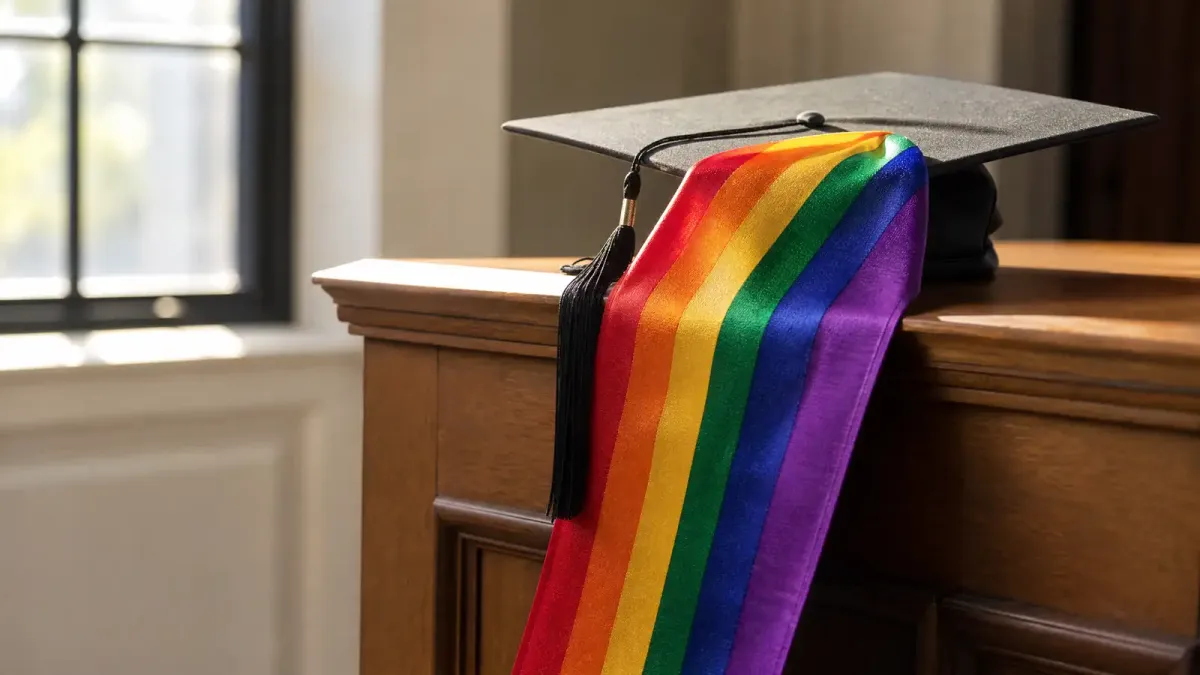
The rainbow stole has become a recognizable symbol. The Point Foundation provides stoles to its graduating scholars, and many institutions create their own regalia. The effect is unmistakable: in a sea of black gowns, these students carry a visual marker of pride that says, I made it here as myself (Point Foundation).
The Stories Behind the Stoles
What happens at a Lavender Graduation can’t be captured by programs and speeches alone. The real impact lives in the individual moments.
At UCLA, one student delivered their Lavender Graduation keynote and realized halfway through that they were speaking to their parents — and coming out to them in public for the first time, surrounded by a community that would hold them regardless of what happened next (UCLA Newsroom). That kind of moment doesn’t happen at traditional commencement. It happens because Lavender Graduation creates an environment where authenticity isn’t just permitted — it’s expected.
Consider the student who grew up in a rural community where they never heard anyone acknowledge being queer. They arrived at college not knowing whether university would offer safety or a new form of isolation. By senior year, they’ve found their people — maybe through an LGBTQ+ student organization, maybe through a gender-inclusive living community, maybe just through the slow accumulation of late-night conversations with roommates who became family. Lavender Graduation is the ceremony where that transformation gets named out loud.
Then there are the graduates who carry both joy and grief to the podium. They’re celebrating four years of hard work while mourning relationships they wish they still had. The parent who won’t be in the audience. The high school friend who didn’t make it to graduation. The parts of their story that still ache. Lavender Graduation makes room for that complexity. It doesn’t ask anyone to perform uncomplicated happiness on a day when everything is complicated.
What Students Actually Say About the Experience
If you’ve never attended a Lavender Graduation, it’s hard to picture what one feels like from the audience’s perspective. The structure varies by campus, but the emotional arc tends to follow a familiar pattern.
The ceremony usually opens with an acknowledgment of the lavender color itself — historically associated with the LGBTQ+ community, from the lavender menace of the 1970s to the lavender graduation sashes that now drape over shoulders in ceremony halls. That historical thread matters. Students aren’t just celebrating their degrees; they’re stepping into a lineage of queer people who fought for the right to exist openly in public spaces.
Name readings form the centerpiece. At some campuses, graduates walk across a small stage while their name, pronouns, and major are announced. At others, each student takes the podium for thirty seconds to share what they’re proud of, who they want to thank, or what they plan to do next. These moments are rarely rehearsed to perfection. They’re genuine, sometimes halting, occasionally tearful — and that’s exactly what makes them powerful.
Awards ceremonies often run alongside the name readings. Many Lavender Graduations include recognition for student organizers, peer mentors, and activists who pushed their institutions toward more inclusive policies. These are the students who filed housing petitions, organized trans awareness weeks, sat on diversity committees, and showed up to administrative meetings with demands and data. Their labor doesn’t appear on transcripts. Lavender Graduation puts it on the record.
Keynote speakers typically come from the ranks of recent alumni — people who sat in the same seats a year or two ago and can speak directly to what happens after the ceremony ends. The advice tends to be practical rather than inspirational: how to find LGBTQ+-friendly employers, how to maintain chosen family connections after graduation, how to navigate healthcare transitions when you’re no longer covered by student insurance. The gap between college support systems and the adult world is real, and Lavender Graduation speakers don’t pretend it doesn’t exist.
The receptions that follow are where the actual community work happens. Graduates find their people in the crowd — the roommates, the club members, the professors who became mentors. Families who traveled specifically for the Lavender ceremony introduce themselves to each other. Someone passes around a sign-up sheet for a post-grad queer alumni group. These informal connections often outlast the ceremony itself.
Why It Still Matters in 2026
The numbers keep growing. More than two hundred campuses now host Lavender Graduations, up from a single ceremony at Michigan three decades ago. The Point Foundation’s 2025–2026 class includes 1,000 LGBTQ+ and ally scholars — a cohort that will include its own graduating class this year, many of whom will walk at Lavender ceremonies (Point Foundation).
But growth isn’t the only measure of impact. What matters more is what these ceremonies do for the students who attend them.
Lavender Graduation validates the work that goes into surviving and thriving as an LGBTQ+ student. That work includes navigating microaggressions in classrooms, advocating for inclusive housing, building chosen families, and sometimes managing mental health challenges that stem directly from minority stress. It also includes the ordinary academic labor that every student performs — papers, exams, internships, research. Lavender Graduation honors both.
The tradition also sends a signal to prospective students. When a university hosts a Lavender Graduation, it communicates that LGBTQ+ students belong there — not as an afterthought, but as a recognized and celebrated part of the campus community (KEG). For high school seniors weighing their options, that signal can be decisive.
If Your Campus Doesn’t Have a Lavender Graduation
Not every campus has caught up. Some institutions are still figuring out how to support LGBTQ+ students through the traditional graduation process alone. If your campus doesn’t host a Lavender Graduation, there are steps you can take.
Start by connecting with your campus LGBTQ+ resource center — or, if one doesn’t exist, with the student organizations that fill that role. The Lavender Graduation Legacy Project offers resources for starting a ceremony, including guidance on structure, speakers, and institutional buy-in (Lavender Graduation Legacy Project). Many student affairs offices are receptive to the idea once they understand what it involves: a relatively small, student-driven event that costs little to produce but generates enormous goodwill.
You don’t need a massive budget or administrative support to begin. Some of the most impactful Lavender Graduations started as student gatherings in borrowed rooms with a handful of speakers and a shared meal. What matters is the intention: creating a space where LGBTQ+ graduates can be fully visible.
The Graduation You Never Had
Dr. Sanlo’s vision extends beyond current students. The Lavender Graduation Legacy Project also encourages LGBTQ+ community centers and organizations to host “The Lavender Graduation You Never Had” — ceremonies for people who graduated before 1995 and never got to experience this kind of recognition (Lavender Graduation Legacy Project).
It’s a small gesture with disproportionate emotional weight. Plenty of LGBTQ+ adults spent their graduation ceremonies counting down the minutes until they could leave, feeling invisible in their own milestone. A delayed Lavender Graduation can’t rewrite the past, but it can offer a different kind of closure: a room full of people who understand exactly what it took to get here, celebrating a journey that may have taken forty or fifty years.
Why These Stories Need Telling
Lavender Graduation ceremonies don’t get much mainstream coverage. They’re not breaking news. They’re not scandals or policy disputes. They’re celebrations — which is precisely why they deserve attention.
Every LGBTQ+ student who walks across a Lavender Graduation stage is modeling possibility for someone younger. Every rainbow stole pinned onto a gown is a signal that says: your identity is not something to leave behind when you succeed — it’s something that helped you get there.
If you’re an LGBTQ+ student approaching graduation, whether you’re heading to a Lavender ceremony or creating one from scratch, the work you’ve already done matters. You’ve navigated a system that wasn’t built for you, found your people, and earned your place. However you choose to celebrate, make it yours.
And if you’re looking for more resources on building community and finding support during your college years, check out our guides on finding LGBTQ+ support systems on campus and navigating campus life as an LGBTQ+ student.