Walking onto a college campus for the first time — or returning for another year — comes with a quiet but persistent question for a lot of LGBTQ+ students: Will I actually belong here?
It’s not the kind of thing most orientation packets answer. You don’t find it in the course catalog or the housing brochure. But it shapes everything: whether you speak up in class, whether you introduce yourself honestly at the dining hall, whether the campus feels like home or just a place you’re passing through.
The good news is that most campuses have more resources, spaces, and communities than they advertise well. The less good news is that finding them takes a little legwork. This guide walks through what’s out there — drawn from real student experiences and the resources that actually exist on campuses in 2026 — so you can spend less time searching and more time settling in.
The LGBTQ+ Resource Center: Your First Stop
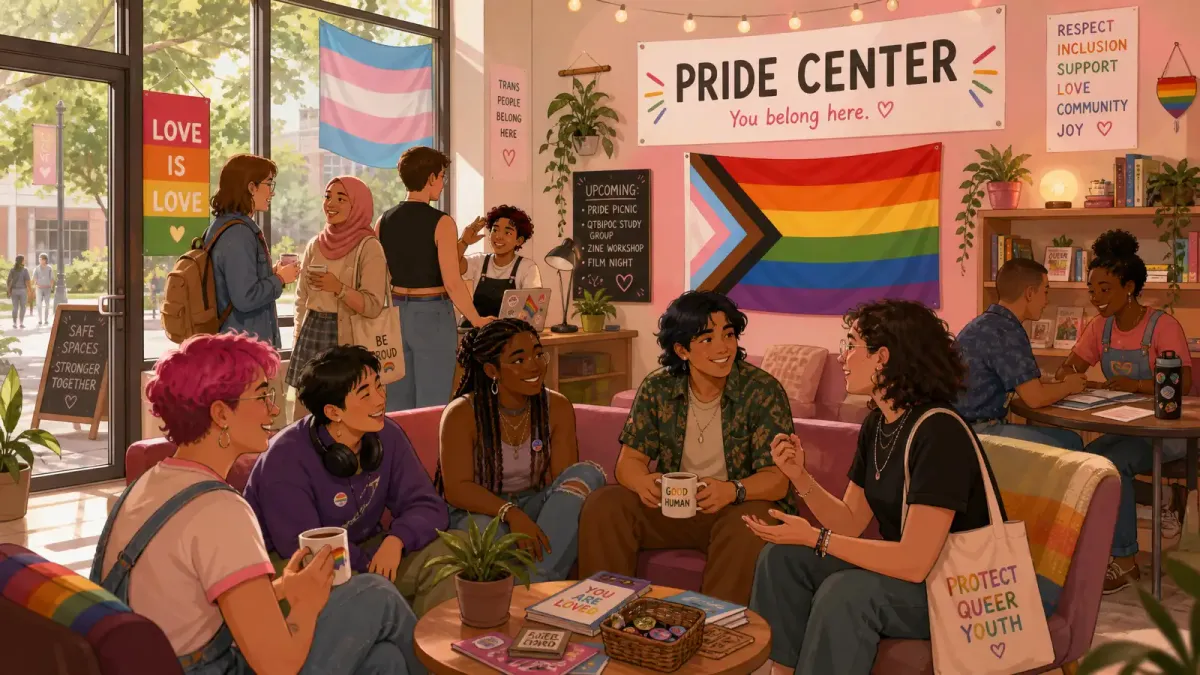
If your campus has an LGBTQ+ resource center (and most mid-size to large schools do), make it one of your first visits. These spaces aren’t just offices with brochures — they’re often the closest thing to a living room queer students have on campus.
The UCLA LGBTQ Campus Resource Center, now in its 30th year, describes what it offers in plain terms: “community building, outreach, training, consultation, resource sharing, counseling referrals, and collective empowerment.” That sounds formal, but in practice it means couches where you can study between classes, staff who will actually listen when you’re having a rough week, and a calendar full of events that don’t require you to explain yourself to anyone.
Penn’s LGBT Center has been doing this work for over four decades. Northeastern’s LGBTQA Resource Center keeps doors open year-round, including summer hours. Even at the University of Kentucky, the LGBTQ* Center maintains daily hours through the summer — 8 a.m. to 4:15 p.m. — because the need doesn’t take a vacation.
What to expect when you walk in: probably someone at a desk who’s genuinely glad you showed up. Maybe a bulletin board covered in flyers for upcoming events. A shelf of queer lit you can borrow. Often, free coffee or tea. These spaces are designed to be low-barrier. You don’t need a reason to be there. You don’t need to be “out enough” or “queer enough.” Hanging out and doing homework counts as participating.
Gender-Inclusive Housing: What It Is and How to Ask for It
For trans, nonbinary, and gender-nonconforming students, the standard “men’s wing / women’s wing” dorm setup ranges from uncomfortable to genuinely unsafe. Gender-inclusive housing changes that: it lets students room with people regardless of the gender they were assigned at birth or how they identify.
More schools offer this than you might think. USC has gender-inclusive spaces across multiple residential buildings — Cardinal Gardens, Century Apartments, and Cowlings and Ilium Residential College. The University of New Hampshire offers gender-inclusive options across its campus. The University of Utah has gender-inclusive rooms available in all its buildings. And schools like CSU Long Beach go a step further with themed communities like Pride House, a dedicated residential space “for students interested in exploring and celebrating diverse sexual orientations, gender identities, and expressions.”
If your school doesn’t advertise gender-inclusive housing clearly, ask. Call or email Residence Life directly. Questions to have ready:
- Is there a gender-inclusive housing option, and if so, which buildings?
- Do I need to specifically request it, or is it part of the standard housing application?
- Can I room with someone of a different gender identity than my own?
- Is the option available to first-year students, or only upperclassmen?
The terminology varies — some schools say “gender-neutral housing,” others “gender-inclusive,” others “open housing.” Don’t let the jargon trip you up. The core question is always the same: Can I choose who I live with based on compatibility, not assigned gender?
A 2025 blog post on Modern Campus’s higher-ed platform laid out the nuances well, noting that many housing offices have seen an uptick in students and families asking about safe housing for trans and nonbinary students. You’re not the first person to ask. You won’t be the last. And your question might be the one that pushes your school to formalize a policy that helps everyone behind you.
Finding the Student Orgs (and Why the Discord Server Matters)
Most campuses have an LGBTQ+ student organization — sometimes called a Queer Student Union, sometimes Pride Alliance, sometimes something else entirely. But what matters isn’t the name; it’s whether the group actually feels like community.
Indiana University Bloomington’s LGBTQ+ Culture Center runs an official Discord server where students connect outside of formal events. That matters, because not everyone can attend a Wednesday evening meeting. Not everyone is ready to walk into a room full of strangers. A Discord server or GroupMe chat lets people participate on their own terms — lurking until they’re comfortable, jumping into conversations about shared interests, finding a study buddy for a tough class.
IU also demonstrates how LGBTQ+ student life is increasingly intersectional. Their BLAQ organization creates space specifically for Black LGBTQ+ students. Their oSTEM chapter supports queer students in science, technology, engineering, and math — fields where being out can sometimes feel isolating. A growing number of schools have similar identity-specific groups: queer students of color collectives, groups for asexual and aromantic students, organizations for LGBTQ+ international students.
If your campus only has one big umbrella LGBTQ+ group, that’s still a starting point. Go to one meeting. You don’t have to speak. You don’t have to come out to anyone. Just showing up and seeing other queer students existing in three dimensions — complaining about midterms, laughing at inside jokes, planning low-stakes events like board game nights or queer prom — is itself a kind of reassurance.
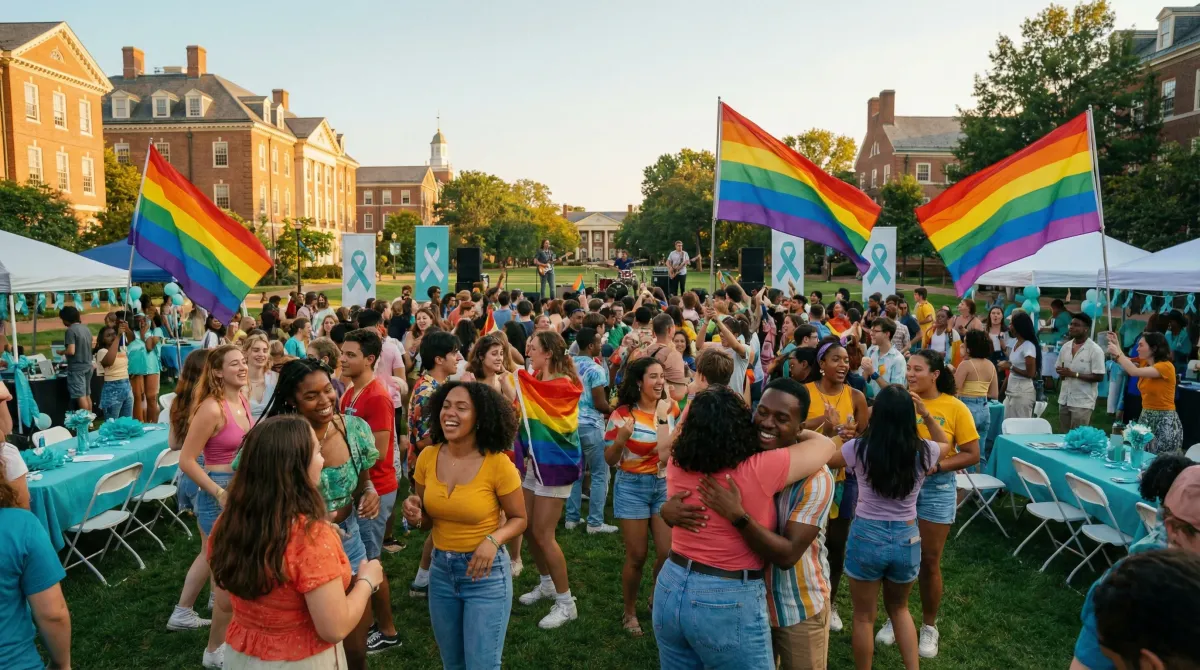
Speaking of queer prom: CSU Long Beach’s Associated Students hosted one this past April. These events aren’t frivolous. For students who never got to attend their high school prom as themselves, or who went but felt invisible, a queer prom is a do-over. It’s small in the scheme of things. It’s also everything.
The Campus Pride Index: A Tool Worth Using
If you’re still choosing between schools, or if you’re already enrolled and wondering how your campus stacks up, the Campus Pride Index (campusprideindex.org) is the most comprehensive public tool available. It rates schools across multiple categories:
- LGBTQ policy inclusion
- Support and institutional commitment
- Academic life
- Student life
- Housing and residence life
- Campus safety
- Counseling and health services
- Recruitment and retention of LGBTQ+ students
Schools that score highly enough make the “Best of the Best” list — the top 30 most LGBTQ-friendly campuses in the country. Elon University has been on that list for seven consecutive years. Other standouts include institutions like Augsburg University, Ithaca College, and the University of Colorado Boulder.
But the index isn’t just about bragging rights. The detailed breakdowns let you see where a school is strong and where it’s weak. A campus might have excellent health services but no gender-inclusive housing. Another might have vibrant student life but lacking institutional policies. Knowing those specifics helps you ask the right questions during campus visits or before you commit to a school.
Summer on Campus: Quieter, But Still Yours
A lot of campus life guides skip summer entirely, as if college shuts down between May and August. It doesn’t. And for LGBTQ+ students who stay on campus — for summer classes, research, jobs, or because going home isn’t a safe or welcoming option — the summer months matter.
Most resource centers operate reduced summer hours but remain accessible. UCLA’s LGBTQ Campus Resource Center operates remotely in July but still provides services. Northeastern’s center runs 9 to 5 through the summer. UKY’s center is open daily.
Summer can actually be an easier time to explore these resources. There’s less competition for space, fewer crowds, more opportunity to have a real conversation with center staff. If you’re an incoming first-year doing a summer bridge program, or a returning student who never quite got around to visiting the center during the academic year, summer is your low-pressure window.
The Small Things That Add Up
Here’s something the brochures won’t tell you: LGBTQ+ campus life isn’t one big thing. It’s a thousand small ones.
It’s the professor who includes their pronouns in their email signature and mentions their wife in casual conversation. It’s the Pride flag sticker on a lab door. It’s finding a copy of Giovanni’s Room on the shelf at the resource center and reading it between classes. It’s the group chat that blows up with memes at 1 a.m. It’s walking into the dining hall with your partner and nobody staring.
These moments don’t cancel out the hard parts — the microaggressions, the bills targeting trans students, the family members who still don’t get it. But they accumulate. Over time, they build something durable: the sense that you’re not alone here, that you’re entitled to take up space, that this campus belongs to you as much as it belongs to anyone else.
Some students find this quickly. For others, it takes semesters. Neither timeline is wrong. You might attend three club meetings before you actually talk to anyone. You might visit the resource center and just sit in the corner with your laptop for weeks before you feel like part of the furniture. That’s not failure. That’s pacing.
Practical Next Steps
If you’re reading this and wondering where to start, here’s a short list:
This week: Look up your campus LGBTQ+ resource center online. Find the hours. Put them in your phone. If they have a newsletter or calendar, sign up.
This month: Visit the center in person. You don’t need a reason. Bring your homework. Ask the person at the front desk what events are coming up. If in-person isn’t your thing, join the Discord or follow the Instagram.
This semester: Go to one event. Just one. It can be a movie night, a guest speaker, a study session. Show up. If it’s not your scene, try a different event next month. If it is, you’ll know.
When you’re ready: Ask about gender-inclusive housing if that’s relevant to you. Look up your school’s score on the Campus Pride Index and see where there’s room to advocate. Consider joining a student org’s leadership — queer student groups need people willing to help plan the next queer prom, organize the next panel, order the next round of pizza.
Every campus is different. The resources available at a small liberal arts college in a rural area won’t match what’s offered at a large public university in a coastal city. But the through-line is the same: somewhere on your campus, there are queer students building community. Find them. Or let them find you.
The door is open. You can walk through it whenever you’re ready.