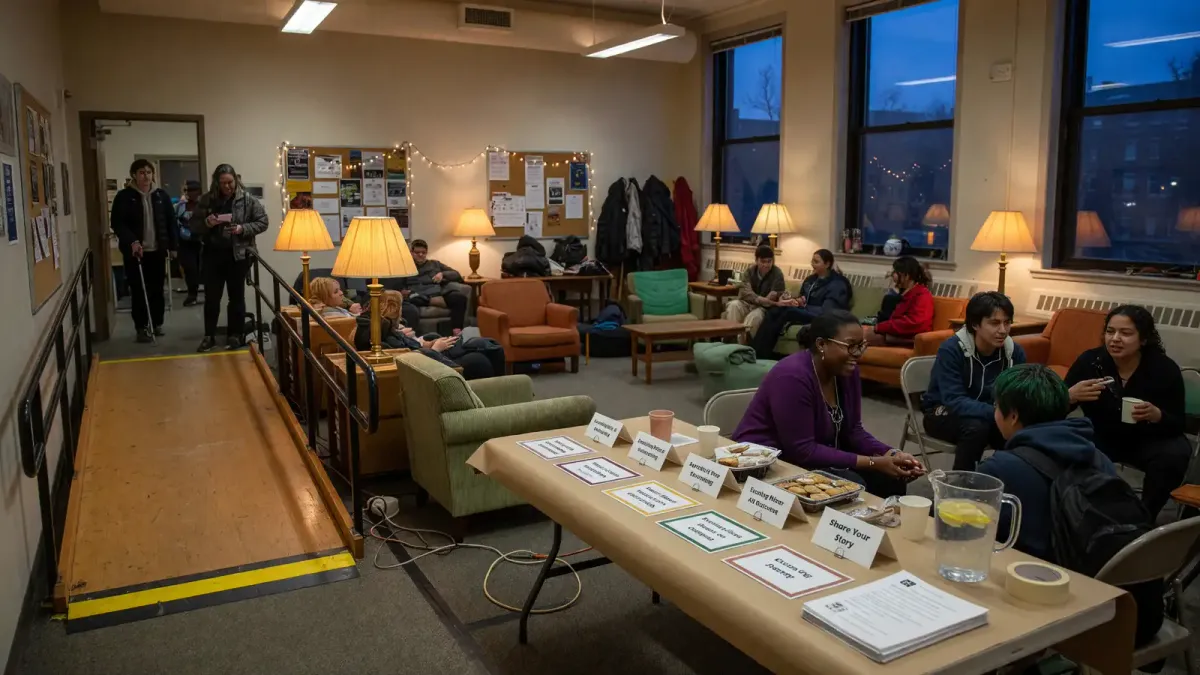
The campus LGBTQ+ center announces a movie night. The flyer is visually striking. The room has a ramp. The organizers introduce themselves with pronouns. By most measures, this is an inclusive event. But the film doesn’t have captions. The room has fluorescent lights that trigger migraines. The discussion afterward assumes everyone can speak verbally and process auditory information in real time. And the disabled queer students who might have come — who might have needed this community most — quietly decide to stay home.
Accessibility in LGBTQ+ spaces is often treated as an afterthought: add a ramp, mention pronouns, check the box. Real accessibility requires thinking about disability and queerness together, not as separate categories that happen to overlap in some people.
The Overlap Is Larger Than You Think
LGBTQ+ people are more likely to have disabilities than the general population. According to multiple studies, queer adults report higher rates of physical, sensory, and cognitive disabilities — not because being queer causes disability, but because minority stress, healthcare disparities, and socioeconomic factors create conditions where disability is more common and less well-managed.
On campus, the student who uses a wheelchair, the student with chronic fatigue, the student on the autism spectrum, and the student managing a mental health condition are all statistically more likely to be LGBTQ+ than the general student population. When LGBTQ+ events aren’t accessible, they’re excluding a significant portion of their intended audience — and often the portion that needs community most.
What Accessibility Actually Requires
Accessibility isn’t a checklist, but here are concrete starting points that LGBTQ+ event organizers can implement:
Physical access. Beyond checking for ramps and elevators, consider: Is there seating available for people who can’t stand for long periods? Are there quiet spaces nearby for people who need to step away from sensory overload? Is the venue reachable by public transit and paratransit? Are service animals welcome without question?
Sensory considerations. Fluorescent lights, loud music, strong scents, and crowded rooms can make events physically impossible for people with sensory sensitivities, migraines, or certain neurological conditions. Offering a quiet room, using adjustable lighting, avoiding scented products, and capping attendance below fire-code maximum all help.
Communication access. Captions for videos, ASL interpretation for speakers (budget permitting), written materials alongside verbal presentations, and multiple ways to participate in discussions (speaking, writing on notecards, using a chat function) make events accessible to Deaf and hard-of-hearing students, students with auditory processing differences, and students who communicate more comfortably in writing.
Cognitive access. Clear schedules distributed in advance, content warnings for potentially distressing material, breaks built into the agenda, and facilitators who summarize key points periodically all help students with cognitive disabilities, ADHD, or mental health conditions participate fully.
Virtual and hybrid options. For students with disabilities that make in-person attendance difficult or impossible, offering a virtual option isn’t a compromise — it’s often the difference between participation and exclusion. The technology has been available since 2020. The barrier is willingness to use it.
The Budget Objection
The most common pushback on accessibility is cost: “We can’t afford ASL interpreters,” or “We don’t have the budget for captioning.” These objections are real — student organizations operate on tight budgets — but they’re also incomplete. Many accessibility measures cost nothing: choosing a quiet venue, providing content warnings, building breaks into the schedule, offering multiple ways to participate in discussion. Others can be funded through the same channels that fund the event itself — if accessibility is treated as a core line item rather than an optional add-on.
Campus disability services offices sometimes provide free ASL interpretation, captioning, or accessibility consultation for student events. The disability cultural center (if one exists) may be willing to co-sponsor. The student government may have accessibility funds that organizations don’t know about.
Beyond Compliance
The most accessible LGBTQ+ events are often the ones planned by people who live at the intersection of queerness and disability. This isn’t to say that non-disabled organizers can’t do this work — they can and should — but that the expertise of disabled queer people isn’t just welcome, it’s essential.
If your LGBTQ+ organization doesn’t have disabled members in leadership, ask why. Is the meeting space inaccessible? Are meetings scheduled at times that conflict with medical appointments or energy management? Are communication norms excluding people who don’t process information in the expected way?
Sometimes the most accessible thing an organizer can say is: “We’re learning. Tell us what you need, and we’ll do our best to make it happen.” And then actually do it.
Queer community has always been built by the people who need it most. The student organizing a Discord server because they can’t attend in-person events, the student requesting captions on the film screening, the student asking if there’s a quiet space — these aren’t burdens. They’re the people telling you how to build community that actually includes them. Listen.