Flourish Health, a youth mental health startup, just raised $26 million in Series A funding. The round was led by B Capital, F-Prime, and Cherryrock Capital — serious investors betting that intensive outpatient care for teenagers and young adults is a growth market worth backing. Flourish is not the only one. Over the past two years, venture capital has poured hundreds of millions into digital mental health platforms aimed at young people, from text-based therapy apps to AI-driven screening tools. These startups are building real infrastructure — hiring clinicians, negotiating insurance contracts, running clinical trials.
One week earlier, the CT Mirror reported that the federal 988 suicide prevention hotline still does not have a dedicated sub-line for LGBTQ+ youth. It has been a full year since the Trump administration pulled the “Option 3” LGBTQ+ pilot program from the 988 system. The Department of Health and Human Services says SAMHSA is “working to resume” the service by the end of 2026, but the obstacle is not technical. It is political. Executive Order 14168, signed on Trump’s first day back in office, rejects transgender identity and directs all federal agencies to align. SAMHSA has been trying to rebuild a service for LGBTQ+ youth while simultaneously complying with an order that excludes trans people from federal policy.
This is the contradiction facing LGBTQ+ college students in 2026. Private money is betting big on youth mental health. Public infrastructure is stuck in a political fight that has nothing to do with what actually works. The question for anyone on a college campus is simple: if you need help tonight, which system actually answers?
The 988 Gap: One Year Without a Lifeline
When 988 launched in July 2022, it was pitched as a simpler alternative to 911 for mental health emergencies. The idea was that anyone in crisis could dial three digits and reach a trained counselor instead of a police dispatcher. It was a genuine improvement over the previous 10-digit National Suicide Prevention Lifeline — easier to remember, less intimidating to call.
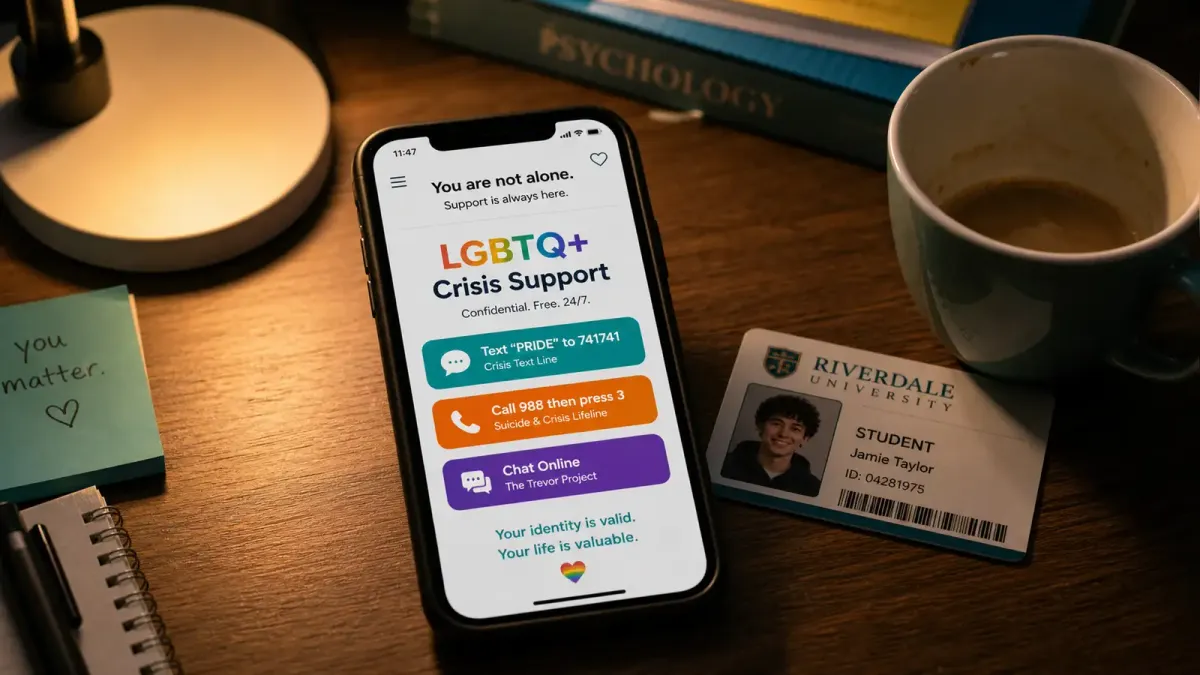
In September 2024, the Biden administration added an LGBTQ+ youth sub-line. Callers could press “3” to speak with a counselor trained specifically on LGBTQ+ issues. The Trevor Project co-piloted the launch. Early data showed the sub-line was being used and that callers reported feeling understood in ways the general 988 line could not match. A teenager calling about suicidal thoughts after being outed to unsupportive parents does not need a generic counselor asking “have you tried deep breathing.” They need someone who understands that the crisis is specific, not generalized.
Trump took office in January 2025. By the end of that month, the sub-line was gone.
Mark Henson, vice president of advocacy and government affairs at the Trevor Project, put it bluntly to the CT Mirror: “If these services do not include transgender youth, which is one of the groups at highest risk for suicide in the country — even higher than overall LGBTQ+ youth — then these are not LGBTQ+ youth specialized services, full stop.”
The stakes are not abstract. LGBTQ+ youth are significantly more likely to attempt suicide and experience depression than their peers. Many are navigating family rejection, discrimination, and bullying on top of the ordinary stress of being young. A crisis hotline staffed by people who do not understand the specific shape of that experience is better than nothing, but it is not the same thing as a specialized service. It is the difference between talking to someone who has read about your situation and talking to someone who has trained for it.
The federal government says it aims to restore the sub-line by the end of 2026. That would mean roughly two years without a dedicated LGBTQ+ crisis line inside the country’s primary mental health emergency system. Two years is a long time to tell a seventeen-year-old trans kid to wait.
Private Money Steps In
While public infrastructure stalls, private capital is moving. Flourish Health’s $26 million raise is one data point in a broader trend. The startup provides intensive outpatient care for children and young adults with serious mental health needs: depression, anxiety, bipolar disorder, trauma-related conditions, suicide attempts. It works with major health plans to coordinate care across psychiatrists, therapists, and guides — essentially building a clinical team around each patient instead of leaving them to navigate a fragmented system alone.
Brett Cook, a partner at F-Prime, described the model as making “team alignment possible at scale, helping psychiatrists, therapists and guides deliver coordinated, high-touch care without losing the human connection.”
The business case is straightforward. CDC data shows only about 20% of children with mental, emotional, or behavioral health disorders receive specialized care. The other 80% are either going without treatment, landing in emergency rooms during crises, or cycling through services that were never designed for coordinated long-term support. That is not a gap. That is a canyon. Any company that can capture even a fraction of that unmet need has a big market, and investors know it.
The problem for LGBTQ+ college students is that venture-backed startups tend to scale through health plan partnerships. Flourish works with major insurers to embed its services as a covered benefit. If you are on your parents’ insurance and your parents are supportive, you might get access. If you are on a university health plan with limited mental health coverage, or uninsured, or not out to your family and afraid of an explanation of benefits showing up in the mail, the startup ecosystem does not reach you. The money is real, but the distribution mechanism filters out the people who often need it most.
What This Means for LGBTQ+ College Students
The split between private innovation and public failure creates a specific kind of precarity. On one side, there is more mental health funding and attention than at any point in recent history. On the other side, the most vulnerable people — trans youth, students without family support, those who need crisis intervention rather than outpatient therapy — are being left behind.
Flourish Health’s founder told Fierce Healthcare that the goal is “providing more robust services so that kids don’t get into such a crisis that they need a hospitalization.” That is a worthy mission and one that will help thousands of young people who are already connected to care. But it describes a system for people who are already inside a care pathway, already have a diagnosis, already have insurance that covers the service. The 988 gap describes what happens to everyone still trying to find the door.
For college students, the practical takeaway is that you cannot count on a single system. The federal 988 line exists and works for general crises. If you are having a panic attack at 2 a.m. and need someone to talk to, 988 will connect you to a counselor. But if your crisis is connected to your identity — to being trans and misgendered by a professor, to being outed to unsupportive parents, to the specific isolation of being the only queer person in your dorm — the general line is a stopgap, not a solution.
Campus counseling centers add another layer of complexity. Many are understaffed, operating on a short-term therapy model with session caps, and some are explicitly limited by state policies that restrict what they can say about gender identity. At a growing number of public universities in states with anti-LGBTQ+ legislation, counselors are navigating legal gray areas about whether affirming a trans student’s identity constitutes a political act. The result is that even campus resources, which should be the most accessible option, can feel uncertain.
Resources That Work Right Now
Several independent hotlines remain operational and are staffed by people trained specifically on LGBTQ+ issues. They are not part of the federal 988 system and are not subject to the executive order that hamstrung the sub-line. These are the numbers to save in your phone.
The Trevor Project runs its own crisis services: call 1-866-488-7386 or text START to 678-678. These lines existed before 988 and continue operating independently. The organization also recently spoke with STAT News about its approach to counseling trans youth specifically, emphasizing that identity-affirming crisis intervention is not a political stance — it is an evidence-based practice. People who feel understood during a crisis are less likely to attempt suicide. This is not complicated.
Other options include the LGBT National Hotline at 888-843-4564, the LGBT National Youth Talkline at 800-246-7743, and the Trans Lifeline at 877-565-8860. Each serves a slightly different population and operates on different hours, so it is worth having more than one number available. The 988 website itself still maintains a resource page for LGBTQ+ people and allies, which links to these external services. It is an awkward workaround — the federal government directing people away from its own system — but it is functional, and it keeps the resources findable for anyone who lands on the official page.
For students on campus, the strongest play is usually a combination: know the crisis numbers, but also identify at least one adult on campus who is demonstrably safe. A professor who includes pronouns in their email signature and has a Safe Zone sticker on their office door. A residence hall director who showed up for the Pride event. A campus minister at the inclusive chapel. These people are not therapists and should not be treated as such, but they can help you navigate the system when you do not have the bandwidth to figure it out alone.
None of this replaces the need for a dedicated sub-line inside 988. The Trevor Project’s Mark Henson made clear that his organization views the current situation as unacceptable and temporary. The question is whether the administration that created the problem will be the one to fix it, or whether LGBTQ+ students will be waiting for a different political landscape before the most obvious crisis resource is restored.
In the meantime, the money flowing into youth mental health startups is real and will help some people. The hotlines are real and will help others. The gap between the two — between a system that works for the insured and one that works for everyone — is where most LGBTQ+ college students actually live. A venture-funded app on your phone and a crisis number saved in your contacts. Both are useful. Neither is enough on its own.