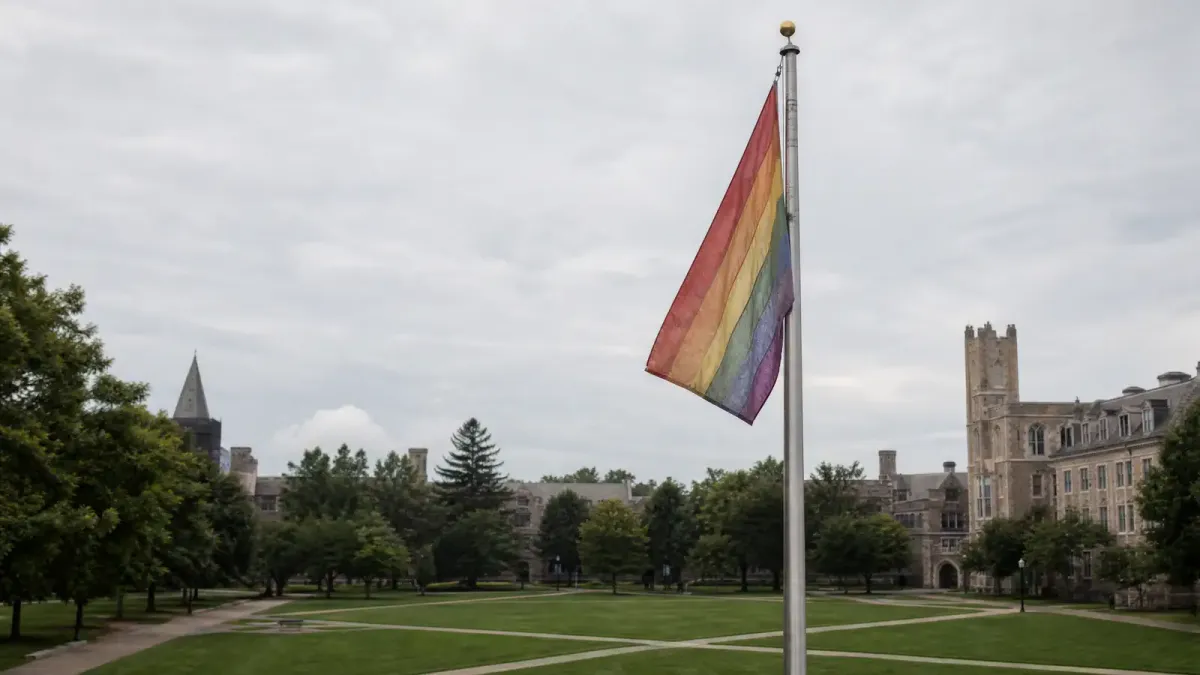
For years, Pride Month meant visible, institutional support at colleges across the country. Administrators flew rainbow flags from campus flagpoles. Official social media accounts posted celebratory messages. Campus organizations hosted panel discussions, film screenings, and community gatherings. For many LGBTQ+ students, seeing their college publicly affirm their identity was one of the most meaningful signals that they belonged.
This year, the picture looks different.
The Quiet Pullback
As Inside Higher Ed reported in June 2026, a growing but still small number of colleges have quietly distanced themselves from Pride Month. The pattern is consistent but subtle: some schools posted Pride Month messages on official social media accounts and then deleted them within hours. Others withdrew from local Pride parades they had participated in for years. A few issued internal directives that effectively prohibited LGBTQ+ Pride flags from being displayed on campus buildings.
These are not the kinds of public, loud policy reversals that make national headlines. They are quiet decisions — the kind that students only notice when they look for the flag that used to be there and find it gone, or when they try to register for an event that has been quietly cancelled.
The effect on students is not quiet at all. For LGBTQ+ students who came to college expecting the same institutional support that previous generations received, the sudden absence of Pride Month visibility sends a clear message — even when the administration insists it is trying to be “neutral.”
Why Is This Happening?
Several forces are converging to create this trend, and understanding them is important if you want to advocate effectively on your campus.
Heightened Political Scrutiny
Under the Trump administration, colleges and universities have faced increased pressure on issues related to gender and sexuality. Federal guidance, executive orders, and the general political climate have created an environment where some institutions see stepping back as the safest course of action. Rather than risk controversy or potential consequences, some administrators have chosen silence.
New State Laws and System Policies
A number of states have passed legislation or university system policies that restrict public colleges from taking official positions on issues involving gender and sexuality. For LGBTQ+ students at public institutions in these states, this means the institutional voice that once affirmed their identity is now legally barred from doing so.
The practical impact varies. Some states explicitly prohibit Pride flag displays on government property. Others use broader language about institutional neutrality that has the same effect. In either case, the result is the same: the rainbow flag that flew from the administration building last year is not flying this year.
Institutional Neutrality Policies
Over the past two years, more colleges have adopted formal institutional neutrality policies — rules that limit the administration’s ability to take public stances on social and political issues. The model most commonly cited is the University of Chicago’s “Kalven Report,” a 1967 statement arguing that universities should remain neutral on contentious social issues in order to protect academic freedom and the open exchange of ideas.
Universities adopting neutrality policies argue that they are protecting all students by not endorsing any particular viewpoint. But many LGBTQ+ students and advocates see it differently. Pride Month statements, they argue, are not partisan political positions — they are affirmations of student dignity and safety. When an administration cites neutrality to justify removing a Pride flag, it is treating LGBTQ+ identity as a debatable political question rather than a matter of basic human respect.
As the American Association of University Professors has noted in its discussions of institutional neutrality, the principle can become a cover for administrative inaction on issues that affect marginalized communities. The line between genuine neutrality and quiet capitulation is thin, and students have every reason to question which side their administration is on.
Not Every College Is Pulling Back
It is important to note that this trend is real but not universal. The majority of colleges still observe Pride Month with public events and statements. And some institutions are actually stepping up their support.
CUNY, for example, launched a new LGBTQ+ Institute in June 2026, signaling a significant investment in support services, research, and community programming for LGBTQ+ students across its campuses. This is the opposite of pullback — it is institutional deepening.
NPR’s coverage of LGBTQ+ rights in 2026 also noted that the policy landscape is far from settled. Even when courts issue rulings on LGBTQ+ issues, state-level actions, campus policies, and student advocacy continue to evolve — often in directions that expand protections rather than restrict them.
Some institutions are stepping up. Others are stepping away. The result is a patchwork where your experience as an LGBTQ+ student depends heavily on where you go to school.
What Students Can Do
If your college is among those pulling back from Pride Month, there are still concrete, effective steps you can take. Here is a playbook based on what student organizers have done successfully at campuses across the country.
1. Document What Has Changed
Start by keeping records. Screenshots of deleted social media posts. Emails about cancelled events. Directives about Pride flags. Documentation matters when you are making the case that these decisions affect real students.
A well-documented record is also useful for campus media, student newspapers, and national organizations that may pick up your story. Inside Higher Ed’s reporting on this trend was only possible because journalists had specific examples from specific campuses. Your campus could be one of those examples.
2. Organize Within Student Government
Student government organizations often have their own budgets, communications channels, and platforms that are not subject to the same institutional neutrality rules that bind the administration. Use student government to:
- Fund Pride events that the administration has cancelled
- Fly Pride flags in student union buildings and residence halls (if those spaces are under student government control)
- Pass resolutions affirming support for LGBTQ+ students
- Invite speakers and host panels that the administration will not sponsor
Student government may not carry the same weight as an official institutional statement, but it carries real resources and legitimacy.
3. Build Alliances
Pride Month pullback does not only affect LGBTQ+ students — it affects the entire campus community’s understanding of what the institution values. That means you have potential allies beyond the LGBTQ+ student organization.
Partner with:
- Civil liberties groups on campus who care about free expression and the difference between neutrality and censorship
- Faith organizations whose traditions affirm LGBTQ+ dignity
- Academic departments — especially gender studies, sociology, and political science — that can frame the issue in scholarly terms
- Alumni networks who may be willing to put pressure on the administration
- Faculty senates that can issue statements independent of the administration
Broader coalitions carry more weight with administrators than any single group acting alone.
4. Use Existing Campus Resources
Many colleges have LGBTQ+ centers, counseling services, or diversity offices that continue to operate regardless of whether the administration posts about Pride Month on Instagram. These resources are still yours to use.
If those resources have been defunded, restricted, or told to avoid “political” programming, that is a separate fight — but it is one that can be won with sustained pressure. Start by asking for a meeting with the director of the relevant office. Ask what support is still available. Ask what has changed and why. And then ask what you can do to help restore it.
5. Know Your Rights
Politico reported in June 2026 that Supreme Court decisions on trans student rights are not the final word on these issues — state laws, campus policies, and student advocacy continue to shape the lived reality of LGBTQ+ students.
Check your state’s nondiscrimination laws. Check your college’s own nondiscrimination policy. Many institutions have protections in place that go beyond what federal law requires. If your college’s Pride Month pullback violates its own stated commitment to nondiscrimination, that is a powerful argument to make — and one that administrators cannot easily dismiss.
6. Connect With National Organizations
You do not have to fight this alone. Organizations like Campus Pride, the Trevor Project, GLAAD, and the ACLU have experience supporting students whose campuses are pulling back from LGBTQ+ visibility. They can provide:
- Guidance on what your legal rights are
- Templates for petitions, letters to the administration, and press releases
- Connections to students at other campuses facing similar situations
- In some cases, direct intervention or public pressure campaigns
The Bottom Line
Pride Month on campus is no longer automatic. For LGBTQ+ students at colleges that are pulling back, the absence of institutional support can feel like a rejection. It is not your fault, and it does not diminish your right to exist and thrive on campus.
The students who are organizing, documenting, and pushing back on their campuses are the ones keeping Pride alive where administrators have gone quiet. If your college is one of them, you are not starting from scratch — you are joining a movement that has been fighting for visibility and dignity for decades.
And that movement, unlike a deleted social media post, is not going anywhere.
Sources: Inside Higher Ed — Colleges Backtrack on Pride Month, NPR — The State Of LGBTQ+ Rights In 2026, Politico — Why the Supreme Court won’t have the final word on trans students, Inside Higher Ed — CUNY Launches LGBTQ+ Institute