How Campus LGBTQ+ Wellness Centers Are Changing Student Mental Health Support in 2026
How LGBTQ+ student support is shifting on college campuses has been one of the quieter stories of 2026. While some universities are scaling back visible Pride programming, others are building permanent structures dedicated to queer student wellness.
A New Model for Institutional Support
In April 2026, the City University of New York’s Board of Trustees unanimously approved the creation of the Institute for LGBTQIA+ Community Engagement and Public History (Inside Higher Ed). The institute builds on CUNY’s LGBTQIA+ Consortium, which started in 2017 serving just five campuses and has since expanded to nearly the entire university system.
What makes this model noteworthy isn’t the scale alone. Allie Brashears, director of CUNY’s LGBTQIA+ Consortium, emphasized that the institute takes a non-prescriptive approach: “We’re not prescriptive in the type of programming we fund. It’s really up to each campus and the representatives and partners who are working with us to come up with their own programming so they can tailor it to their student population.”
This flexibility matters. CUNY serves a highly diverse student body — immigrants, first-generation students, students from lower-income backgrounds. Their wellness needs don’t fit a single template.
Why Human-Centered Care Matters
The conversation around campus mental health support has also sharpened its focus on human connection. A recent piece in the Daily Utah Chronicle argued that artificial intelligence tools, despite their accessibility, “aren’t sufficiently equipped to help each student with mental health support” (Daily Utah Chronicle). The University of Utah has been exploring ways to combine AI efficiency with human judgment — a hybrid model that could inform how LGBTQ+ wellness programs are designed.
For queer students, the human element carries extra weight. Minority stress — the chronic stress experienced by stigmatized groups — doesn’t resolve through algorithmic interventions alone. Peer counselors, identity-affirming therapists, and community spaces remain essential.
The Inclusion Imperative
The push for dedicated wellness infrastructure arrives alongside a broader national conversation about LGBTQ+ inclusion in education. A Chicago Board of Education member wrote in a recent Chicago Tribune commentary that schools “cannot help students succeed if it first asks some of them to hide” (Chicago Tribune). When students feel invisible, unsafe, or ashamed of their identities, academic success becomes secondary to survival.
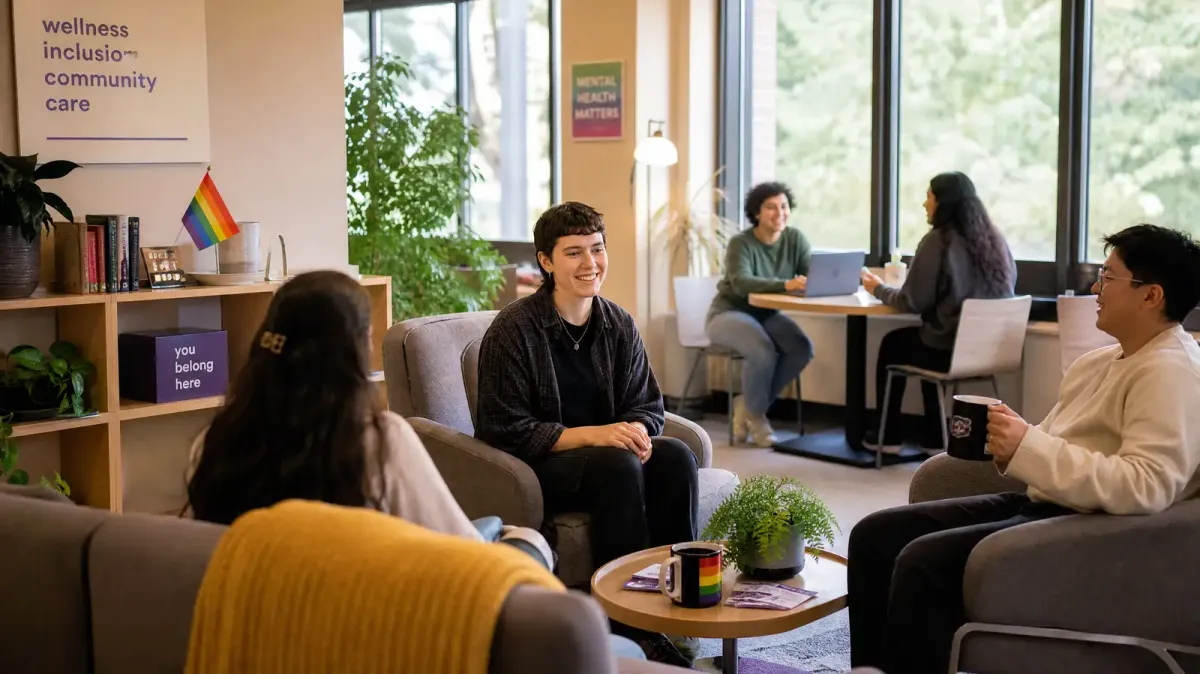
Wellness centers that explicitly welcome LGBTQ+ students send a different message: you belong here, and your wellbeing is part of our institutional mission.
What’s Working on Campuses
Based on emerging models, several approaches are showing promise:
- Campus-specific programming rather than centralized mandates — letting individual campuses design services around their actual student demographics
- Intersectional frameworks that recognize LGBTQ+ students also navigate race, class, immigration status, and disability
- Peer counseling networks complementing professional mental health services
- Dedicated physical spaces — not just a flyer on a bulletin board, but a room where students can gather, study, and find quiet support
What You Can Do
If your campus doesn’t yet have dedicated LGBTQ+ wellness programming, here are steps that have worked at other schools:
- Connect with existing consortiums — many state university systems have statewide LGBTQ+ initiatives that can help seed campus-level programs
- Start with peer support — a student-run group with faculty sponsorship can demonstrate demand and build the case for institutional funding
- Survey your peers — collect data on what your campus’s LGBTQ+ students actually need. The CUNY model works because each campus designs programming based on its own population’s reality
- Link with community organizations — local LGBTQ+ centers often welcome campus partnerships and can provide resources your school can’t fund independently
The Bigger Picture
The contrast between universities that are expanding LGBTQ+ support and those that are retreating from it reveals something important: student wellbeing isn’t a partisan issue, it’s an institutional responsibility. Schools that build permanent structures — not just temporary Pride month displays — are investing in outcomes that extend far beyond graduation.
For students navigating college while also navigating identity, having a wellness center that understands their specific needs can be the difference between thriving and merely surviving.